The Human Side of Health Technology: Stories That Matter
A research-based look at why human side health technology stories matter, from community trust and worker adoption to referral follow-through in global health programs.
The Human Side of Health Technology: Stories That Matter
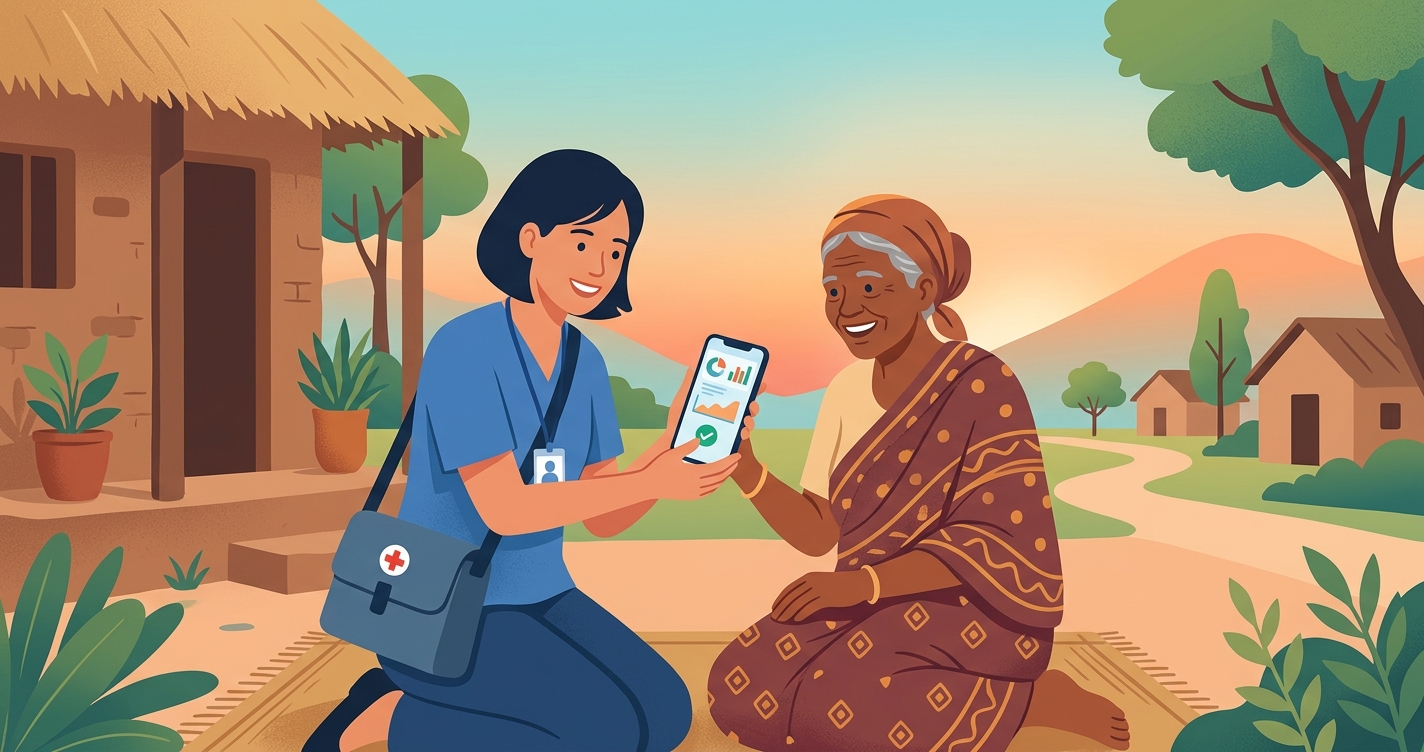
The human side health technology stories that matter are usually not the glossy launch stories. They are the quieter ones: the village health worker who learns how to explain a screening result in local language, the mother who decides to follow a referral because she trusts the person holding the phone, the supervisor who notices that a tool is technically sound but emotionally awkward in the field. In global health, those moments are not soft extras. They often determine whether a program is used, trusted, and sustained.
"Community health workers described mHealth tools as improving task efficiency, competence, trust, and perceived professionalism." — Irene W. Muinga and colleagues, BMJ Open (2023)
Why the human side health technology stories matter in the first place
There is a habit in health technology to talk as if adoption were mainly a hardware problem. Better camera, better battery, better dashboard, better algorithm. Those things matter. But the field evidence keeps saying something slightly different: people adopt technology through relationships.
In the 2023 BMJ Open qualitative study from Kenya, Irene W. Muinga and colleagues examined how community health workers experienced digital health tools and how trust formed around them. One of the clearest findings was that workers did not separate the tool from the social setting around it. Training, supervision, reliability, and how patients reacted to the device all shaped whether the technology felt credible.
That tracks with what public health teams see in practice. A device can shorten a workflow and still fail if it makes the interaction feel cold. It can also add a small amount of friction and still succeed if it helps workers explain risk more clearly and patients feel respected.
The stories behind adoption usually fall into a few patterns
- trust stories: the patient decides whether the tool feels legitimate
- translation stories: the worker turns technical output into language a family can act on
- follow-through stories: referral and treatment depend on what happens after the first reading
- dignity stories: people remember whether the interaction felt respectful or extractive
What people remember is rarely the software spec
When field programs are evaluated later, communities rarely talk first about data architecture. They talk about encounters. Did the worker explain what was happening? Did the screening feel useful? Did anyone come back? Did the referral lead somewhere real?
That is why human side health technology stories matter so much for institutional readers too. Academic researchers, ministries, and funders are not only buying a tool. They are buying the probability of repeated use in real settings.
A useful way to think about it is this: technology generates readings, but people generate meaning.
| Human factor | What it changes in the field | What strong programs do |
|---|---|---|
| Trust in the worker | Willingness to complete a scan or answer questions honestly | Use familiar frontline staff and consistent follow-up |
| Quality of explanation | Whether patients understand why a result matters | Train workers to translate results into plain language |
| Perceived dignity | Whether the interaction feels respectful rather than invasive | Keep workflows short, calm, and consent-driven |
| Referral confidence | Whether a person actually continues to care | Pair screening with realistic next steps and local facilities |
| Community narrative | How the program is discussed after the team leaves | Share outcomes back with communities, not just donors |
Community trust is built one interaction at a time
The best screening programs do not simply collect data from communities. They create a believable social exchange. The patient gives time, attention, and sometimes sensitive information. In return, the program has to offer clarity, respect, and some visible path forward.
That is where stories become operational, not sentimental. In After the Scan: How Referral Pathways Work in the Field, this microsite covered a 2018 Uganda study by Jana Jarolimova and colleagues showing that 89% of caregivers reported taking a referred child for further evaluation. Those numbers were strong partly because the referral made sense within a trusted local system. The worker's recommendation carried weight.
The reverse pattern appears in chronic disease programs. The 2025 quasi-experimental Uganda study by Andrew Marvin Kanyike, Raymond Bernard Kihumuro, Timothy Mwanje Kintu, and colleagues found that village health teams screened 5,215 adults, with 22.4% showing elevated blood pressure. Yet only 23.8% accepted referral, and only 24.8% of those who accepted reached the facility. That is not just a logistics story. It is also a human story about urgency, comprehension, time, cost, and belief.
The worker experience shapes the patient experience
One thing I keep coming back to is how often global health writing treats frontline workers like delivery infrastructure. They are described as channels, cadres, or nodes. All technically true, and still incomplete.
Workers are interpreters. They absorb training, improvise around local barriers, and decide how a tool enters the room.
The WHO guideline on optimizing community health worker programmes, published in 2018, makes this point in a more formal way. Community health workers perform better when they receive proper training, supportive supervision, and integration with the wider health system. In other words, empathy and consistency do not appear by magic. Programs have to build for them.
That matters for digital health because a stressed, undersupported worker usually cannot deliver a warm, convincing technology interaction. Even a good device can feel brittle in the hands of a worker who has not been given enough time, practice, or backup.
What field teams learn fairly quickly
- adoption improves when workers feel more competent, not more monitored
- communities respond better when tools are introduced by someone they already know
- repeated visits matter more than impressive demos
- a clean explanation of next steps often matters more than a precise technical description
Stories help institutions see what dashboards miss
Dashboards are good at counting scans, referrals, turnaround times, and sync rates. They are worse at showing why people stopped participating or why one district quietly outperformed another.
That is where narrative evidence becomes useful. Not because stories replace metrics, but because they explain them.
A district with lower completion rates may not have a weaker tool. It may have weaker community trust. A site with slower uptake may be operating in a language environment where the workflow script does not translate cleanly. A worker cohort with stronger retention may simply have better supervision.
This is one reason digital storytelling and narrative methods have become more visible in health promotion research. Reviews of digital storytelling in health equity work have argued that stories can surface lived experience, cultural meaning, and barriers that conventional reporting tends to flatten. For global health institutions, that is not a branding insight. It is an implementation insight.
Industry applications for researchers, ministries, and funders
Community screening programs
In community screening, human stories often reveal why participation changes over time. Early enthusiasm can make a pilot look stronger than it really is. Later stories from workers and households show whether the program is becoming routine or merely tolerated.
Maternal and child health programs
In maternal and newborn care, relationships often carry more weight than device novelty. The work by Gertrude Namazzi, Monica Okuga, Moses Tetui, and colleagues in Global Health Action showed how community worker engagement can improve knowledge and reach, while transport and motivation remain practical constraints. Those constraints sound ordinary. They are also decisive.
Research and grantmaking
For researchers and grant bodies, stories are often early warning signals. If multiple workers describe the same consent confusion, referral friction, or discomfort among patients, that is operational evidence. Waiting for those issues to become obvious in aggregate outcome data can take months.
Current research and evidence
The literature does not say that human stories are a nice complement to digital health. It says they are part of the mechanism.
In Kenya, Irene W. Muinga and colleagues found that trust around digital health tools was tied to worker competence, stakeholder relationships, and program support structures, not just the app itself (BMJ Open, 2023). That is a useful corrective for anyone who thinks adoption can be solved through product design alone.
In Uganda, Jana Jarolimova and colleagues showed that referral uptake in child health pathways can be high when the pathway is socially legible and the worker's advice is credible (Malaria Journal, 2018). In another Ugandan context, Andrew Marvin Kanyike and colleagues showed that identifying risk is not the same as moving people into care. Their hypertension screening study found major drop-off after detection, even when the screening was surfacing real cases (Journal of Health, Population and Nutrition, 2025).
The WHO's 2018 guidance on community health worker programmes adds the systems frame around these findings. Trust is easier to talk about as an interpersonal quality, but the evidence suggests it is partly structural. It grows when supervision, training, workflow design, and referral capacity are all present together.
The Future of health technology will still be deeply human
The next phase of health technology in global health will almost certainly bring better sensors, lighter workflows, and more capable analytics. That part is easy to imagine.
What should not get lost is the simple fact that most people encounter health technology through another person. A worker. A nurse. A volunteer. A field coordinator. A researcher. The human interface remains the first interface.
That is why the strongest programs will probably be the ones that treat stories as usable evidence. Not sentimental anecdotes for the final report, but practical information about trust, dignity, comprehension, and follow-through.
Solutions like Circadify's research work sit inside that broader shift. The technology can make screening lighter and more portable, but its real value depends on how people experience it in the field.
For related reading on this microsite, see How Community Champions Drive Health Technology Adoption and Health Screening Programs and Community Trust.
Frequently Asked Questions
Why do human stories matter in health technology?
They show how people actually experience a tool. Stories reveal whether patients trust the worker, understand the result, and follow through after screening. Those factors strongly affect adoption and outcomes.
Are stories useful for researchers and funders, or only for communications teams?
They are useful for researchers and funders too. Narrative evidence can explain why metrics move, surface implementation barriers early, and show whether a program feels credible in the communities it serves.
What does the research say about trust and digital health tools?
Qualitative research from Kenya by Irene W. Muinga and colleagues found that trust depended on worker competence, program support, stakeholder relationships, and the reliability of digital tools, not on the software alone.
Do strong stories mean a program is effective?
Not by themselves. Stories should not replace outcome data. But they can reveal whether the conditions for sustained use, trust, and referral completion are actually in place.