How Community Feedback Shapes Digital Health Programs
A research-based analysis of how community feedback shapes digital health programs, from design choices and worker adoption to trust, referrals, and long-term use.
How Community Feedback Shapes Digital Health Programs
Community feedback digital health programs do better when feedback is treated as operating data rather than courtesy. That sounds obvious, but field programs still fall into the same trap: they measure sign-ups, screenings, or device distribution, then treat community response as anecdotal. In practice, the comments from caregivers, village leaders, and frontline workers often explain why a program sticks, stalls, or quietly fades after the pilot phase.
"Digital health initiatives must be guided by a robust strategy that integrates financial, organizational, human and technological resources." — World Health Organization, Global Strategy on Digital Health 2020–2025
Why community feedback digital health programs need is usually operational, not decorative
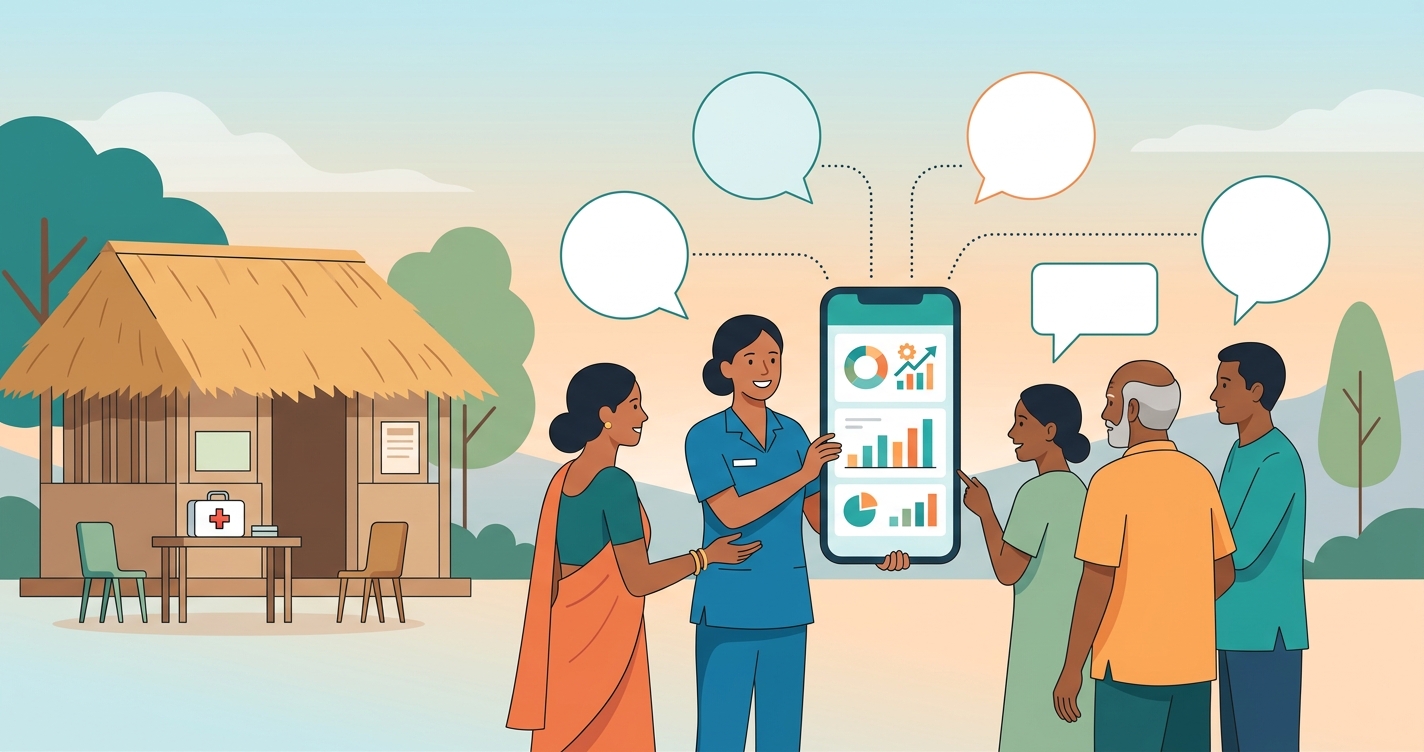
I keep coming back to a simple point here. Communities usually tell programs what is broken long before dashboards do. They notice when a screening flow feels confusing, when a referral destination is unrealistic, when a phone-based workflow adds time to a visit, or when a digital tool makes a worker look more credible. Those reactions are not side notes. They are implementation evidence.
In Uganda, Moses Tetui and colleagues wrote in a 2023 stakeholder study on community health worker program sustainability that local ownership, supervision, and practical support remain central to long-term program performance. That matters for digital health too. A tool can be technically sound and still fail if the people using it, or receiving care through it, feel it does not fit the way local care actually works.
A second lesson comes from the gap between enthusiasm and actual usage. A 2024 study on community health workers in Uganda found that workers often accepted digital health tools in principle, but real-world use lagged because of structural barriers such as limited smartphone access and connectivity constraints. That is exactly the kind of thing community feedback surfaces early. Acceptance is not the same as usability.
What community feedback usually changes in field programs
| Feedback signal | What it often reveals | Program decision it should influence |
|---|---|---|
| Patients ask repeated questions after screening | Results are not being explained clearly | Rewrite scripts, simplify outputs, retrain workers |
| Workers avoid certain app steps | Workflow is too slow or awkward in the field | Shorten forms, reduce taps, add offline modes |
| Referrals are accepted but not completed | Transport, trust, or clinic fit is weak | Redesign referral destinations and follow-up |
| Community leaders raise fairness concerns | Coverage feels uneven or exclusionary | Adjust rollout sequence and communication |
| Workers say a tool improves credibility | Digital support is strengthening trust | Preserve visible workflow elements that help rapport |
| Households stop engaging after first contact | The program feels extractive or one-sided | Add follow-back, reporting, and local feedback loops |
That table is less glamorous than a product roadmap, but it is usually closer to reality.
- Community feedback often points to workflow friction before monitoring systems catch it.
- Frontline worker feedback is especially useful because workers see both the tool and the household reaction.
- Programs that close the feedback loop tend to build more trust over time.
- Programs that collect feedback but do not act on it usually lose credibility fast.
Industry applications in field deployments
Community health worker workflows
The first place feedback shows up is in daily worker behavior. If a digital form takes too long, workers skip steps. If a script sounds unnatural, they paraphrase it. If a screening tool helps them explain risk more clearly, they use it with more confidence.
That pattern showed up in the Uganda research on digital health acceptance and use. Workers did not reject digital tools as a concept. The bigger issue was whether the surrounding conditions allowed consistent use. From an implementation standpoint, that is a useful correction. Programs should spend less time asking whether workers "like" the technology and more time asking what gets in the way of using it during an ordinary day.
Community engagement and local ownership
The strongest programs usually have some way for households and local leaders to shape the service, even if the mechanism is simple. It might be a village meeting, a supervisor check-in, or structured debriefs with community health workers after outreach days. What matters is that feedback changes decisions.
The inSCALE Uganda trial is a good example of why this matters. The trial, published in PLOS Digital Health, tested mHealth support and community innovation models for community health workers managing malaria, diarrhoea, and pneumonia. One arm included village health clubs designed to strengthen appreciation and support for workers. That is easy to miss if you only look at the digital layer. But it gets at something important: technology adoption is often social before it is technical.
Program design for low-resource settings
Community feedback matters even more when infrastructure is inconsistent. In low-resource settings, a design flaw is not a mild annoyance. It can mean a missed household, a failed upload, or a referral that never happens.
The World Health Organization's digital health strategy makes this point in broad terms by arguing that digital initiatives need to integrate human and organizational realities, not just technological ones. In field deployment terms, that means a program has to fit local staffing, supervision, training, power access, and patient expectations. Community feedback is how teams find that fit.
Current Research and Evidence
The evidence on this is spread across implementation studies rather than one single headline paper, which honestly makes sense. Feedback changes programs in many small ways.
In the Uganda stakeholder study, Moses Tetui and colleagues described sustainability as something built through coordination, motivation, and community-level ownership rather than through tools alone. I think that is the right frame. A digital health program lasts when people around it keep believing it is worth the effort.
The 2024 Uganda study on the gap between digital health acceptance and actual usage among community health workers adds a second layer. Workers generally viewed digital tools positively, but structural constraints still blocked regular use. That finding matters because it stops teams from confusing approval with implementation success. If workers say a tool is useful but cannot access phones reliably, the feedback is not mixed. It is specific.
Then there is the inSCALE evidence. In the Uganda cluster randomized trial, Sophie Goudge, Milly Nankinga, and colleagues found that community and mHealth innovations improved appropriate treatment for common childhood illnesses and reduced community health worker attrition. I would not reduce that result to "the app worked." The broader lesson is that programs improved when support systems around workers improved too.
A wider design lesson comes from the 2025 Journal of Medical Internet Research systematic review on co-designing digital health interventions with end users. The review found that co-design is widely endorsed but often difficult in practice because teams struggle with recruitment, power imbalances, and translating user input into concrete design decisions. That sounds familiar to anyone who has watched a pilot collect beautiful feedback notes and then ship the same workflow anyway.
Across these studies, four evidence-backed themes keep showing up:
- feedback works best when it is tied to actual design or workflow changes
- worker adoption depends on logistics as much as attitudes
- social support around frontline workers improves implementation quality
- local ownership is one of the strongest predictors of whether a program survives beyond the pilot stage
For related field reporting on this microsite, see How Health Screening Programs Build Trust in Communities and After the Scan: How Referral Pathways Work in the Field.
The future of community feedback digital health programs use
The next wave of digital health deployments will probably collect more feedback automatically. The question is whether teams will get better at using it.
I suspect the programs that hold up over time will be the ones that combine formal metrics with ordinary local listening. Not just NPS-style surveys, but worker debriefs, referral follow-up notes, community leader concerns, and repeated household questions. Those are often the earliest signs that a workflow is too rigid, a message is landing badly, or a digital tool is earning trust.
There is also a deeper shift happening. More grant-making bodies and research partners now want evidence that a program is acceptable, equitable, and sustainable, not merely deployed. That pushes feedback from the margins into the center of evaluation.
For teams watching this space, solutions like Circadify fit into that broader move toward lighter, field-friendly digital health workflows. The important thing, though, is not to imagine that any tool replaces community response. In real programs, feedback is what tells you whether the workflow belongs in the field at all.
Frequently Asked Questions
Why is community feedback important in digital health programs?
Community feedback shows whether a program actually fits local care routines, trust dynamics, referral patterns, and worker capacity. It often reveals implementation problems earlier than top-line performance metrics do.
Who gives the most useful feedback in field digital health programs?
Usually the most useful feedback comes from frontline workers, patients, caregivers, and local leaders together. Each group sees a different part of the workflow, so their observations are complementary rather than redundant.
Does positive feedback mean a program will scale successfully?
Not by itself. A program can be well liked and still fail because of device access, connectivity, supervision gaps, staffing pressure, or weak referral pathways.
How should teams collect feedback in low-resource deployments?
The best methods are usually simple and repeatable: worker debriefs, structured supervisor check-ins, short household interviews, community meetings, and follow-up on missed referrals.
What is the biggest mistake programs make with community feedback?
The biggest mistake is treating feedback as consultation theater. Once communities realize their input is collected but not acted on, trust drops quickly.