What happens when the nearest doctor is a six-hour walk away?
For millions, a six-hour walk is the reality of healthcare access. This report explores how community health workers armed with smartphones are bridging this gap, with real mHealth deployment stories from across Africa.
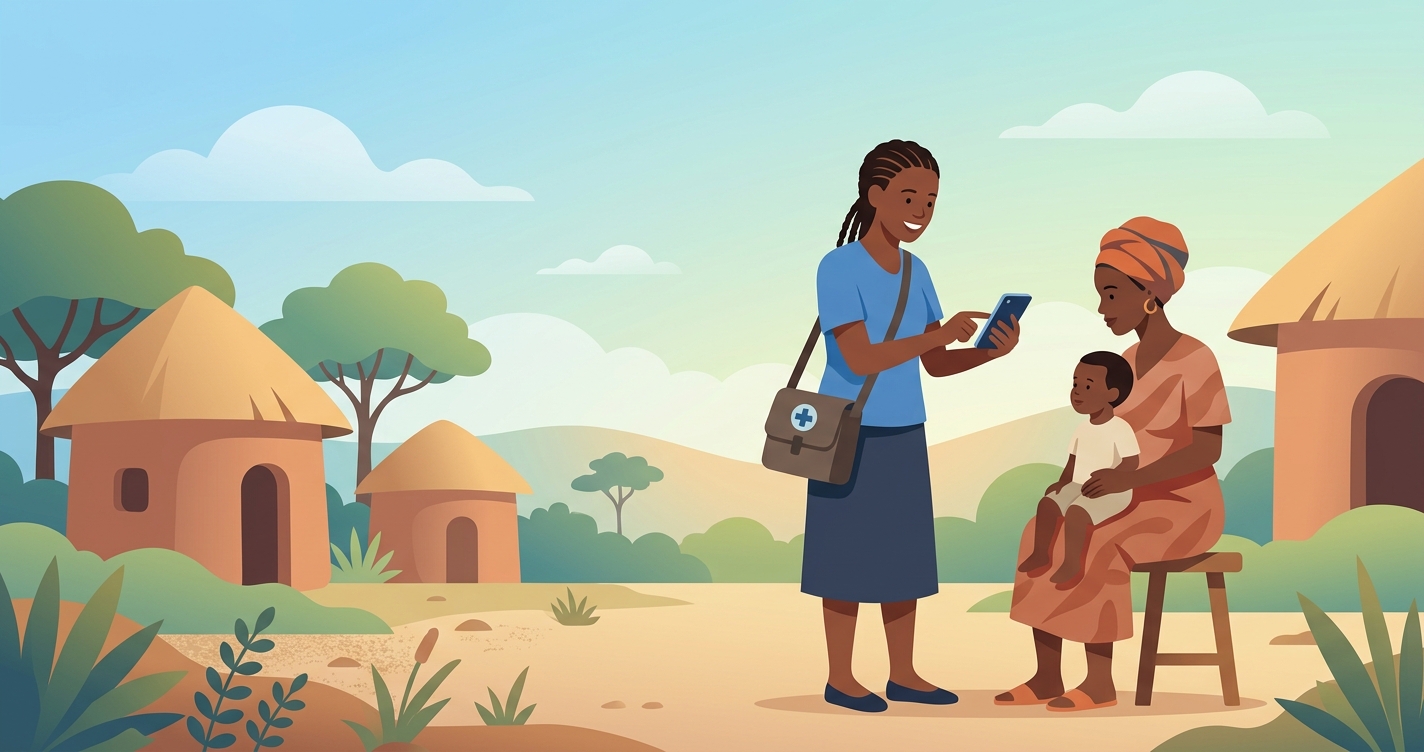
For millions of people in rural and remote regions, the nearest qualified doctor isn't a short drive away; they are a six-hour walk away. This is not a hypothetical scenario but a daily reality that shapes health outcomes for entire communities. The vast distances between patients and clinical care create a persistent barrier to timely diagnosis, routine check-ups, and emergency intervention. In these environments, preventable conditions escalate, and treatable illnesses become life-threatening. This "tyranny of distance" is one of the most significant challenges in global health today. However, a powerful combination of human ingenuity and mobile technology is emerging as a formidable solution: community health workers (CHWs) equipped with smartphone-based diagnostic and data collection tools. These mHealth deployments are not just pilots; they are increasingly sophisticated, data-driven programs that are changing the calculus of healthcare delivery in underserved areas.
"In Sub-Saharan Africa, studies have shown that mHealth interventions led by community health workers were associated with an increase in facility-based births in 89% of cases and a 75% increase in postnatal care use." - (Based on a 2022 systematic review in JMIR)
The new frontline: mhealth deployment stories
The real story of mobile health's impact is not written in code but in the daily work of CHWs. These are the mHealth deployment stories that demonstrate how technology can be a bridge across the last mile of healthcare. In Kisumu County, Kenya, a partnership between the local government and the NGO Living Goods has equipped over 3,000 CHWs with digital tools. The results, tracked over several years, are striking. Facility delivery rates have climbed to over 92% in 2023, a dramatic increase from 69% in 2019. The immunization rate for children has followed a similar trajectory, exceeding 93%. These are not just numbers; they represent a fundamental shift in access to care, driven by CHWs who use smartphones to register pregnancies, screen for danger signs, and ensure mothers deliver their babies in a safe clinical environment. This success is a direct result of treating CHWs as professionals, providing them with the digital tools, training, and support they need to be effective.
The power of these programs lies in their ability to make the invisible visible. Before the widespread use of mHealth applications, a CHW's work was often ephemeral, recorded on paper forms that were slow to travel and difficult to aggregate. Today, every screening and every home visit can be logged in real-time, creating a wealth of data that can be used to manage patient care, track disease outbreaks, and allocate resources more effectively. The Kenyan government, recognizing this potential, recently launched an upgraded national electronic Community Health Information System (eCHIS), which was modeled on the successful digital tools used by Living Goods and their partners. This move to a national, standardized platform highlights a growing understanding that mHealth is not just a collection of standalone projects but a critical component of national health infrastructure.
| Feature | Traditional Health Outreach | mHealth-Enabled Outreach |
|---|---|---|
| Data Collection | Paper-based, slow, prone to error | Real-time, digital, more accurate |
| Patient Follow-up | Manual, often inconsistent | Automated reminders, structured referral pathways |
| Supervision | Infrequent, requires travel | Remote, data-driven performance dashboards |
| Health Worker Motivation | Relies on intrinsic factors | Enhanced by professional tools, sense of connection |
- Real-time data from the field allows for faster response to health trends.
- Digital records reduce the burden of paperwork on community health workers.
- GPS tracking can verify that CHWs are reaching the most remote households.
- Standardized screening protocols are embedded in the software, improving quality of care.
Industry Applications
Scaling national health programs
The lessons from localized mHealth deployment stories are now being applied at a national scale. Governments in countries like Uganda and Burkina Faso are working with partners to develop national community health strategies that have digital tools at their core. This involves not just distributing phones but creating a comprehensive system for training, supervision, and compensation.
Enhancing grant-making and research
For academic researchers and grant-making bodies, the data generated by mHealth platforms offers an unprecedented view into the effectiveness of community health programs. It allows for more rigorous evaluation of what's working and what's not, enabling a more evidence-based approach to funding and program design.
Improving supply chains
One of the most persistent challenges in remote healthcare is keeping essential medicines in stock. mHealth applications are increasingly being used to track medicine inventory at the community level, providing an early warning system for stockouts and allowing for more efficient distribution.
Current research and evidence
The academic and public health communities are actively studying the impact of mHealth interventions. Researchers like Alain Labrique, founder of the Johns Hopkins University Global mHealth Initiative, have been instrumental in building the evidence base for digital health. A 2022 systematic review published in the Journal of Medical Internet Research (JMIR) synthesized the findings of numerous studies and found a strong correlation between CHW-led mHealth programs and improved maternal and child health outcomes. Specifically, the review noted significant increases in antenatal care attendance and facility-based births, providing strong evidence for the effectiveness of these programs. However, research also highlights the challenges. A study on mHealth adoption in Malawi, published in BMC Health Services Research in 2021, pointed to the critical importance of reliable network coverage and consistent technical support for CHWs.
The future of mhealth deployment
The future of mHealth is not just about more advanced technology, but about deeper integration into the healthcare system. As smartphone penetration continues to grow and mobile networks expand, the potential for mHealth to reach even the most remote communities will increase. The next wave of innovation will likely focus on incorporating more advanced diagnostic tools, such as AI-powered analysis of images and sounds, and on creating more seamless links between community-based screening and clinical care. The goal is to create a "digital ecosystem" for health that supports patients and providers at every level of the system.
Frequently asked questions
What are the biggest challenges to mHealth deployment in Africa? The most significant challenges are often not technological but logistical and systemic. These include patchy network coverage in rural areas, the need for reliable electricity to charge devices, and the importance of ongoing training and technical support for community health workers.
How are community health workers compensated for their work with these digital tools? This varies widely by country and program. However, there is a growing consensus that CHWs should be treated as professional members of the health workforce and receive fair, consistent compensation for their work. Many programs are moving away from volunteer models and toward salaried or performance-based payment systems.
Can mHealth tools be used to diagnose diseases? Most current mHealth tools used by CHWs are for screening and data collection, not for definitive diagnosis. They help to identify individuals who are at risk or who show potential danger signs, and then refer them to a clinic or hospital for diagnosis and treatment by a qualified clinician.
As the global health community continues to tackle the challenge of healthcare access, the role of community health workers armed with digital tools will only grow in importance. Organizations like Circadify are at the forefront of developing the next generation of contactless screening technologies that can be deployed in these settings, further empowering CHWs to save lives. To learn more about the research shaping these and other global health innovations, visit circadify.com/blog.