What if you could screen a whole family for health risks from your phone?
How phone-based family screening is reshaping community health program outcomes, with field evidence and validation data for public health funders and researchers.
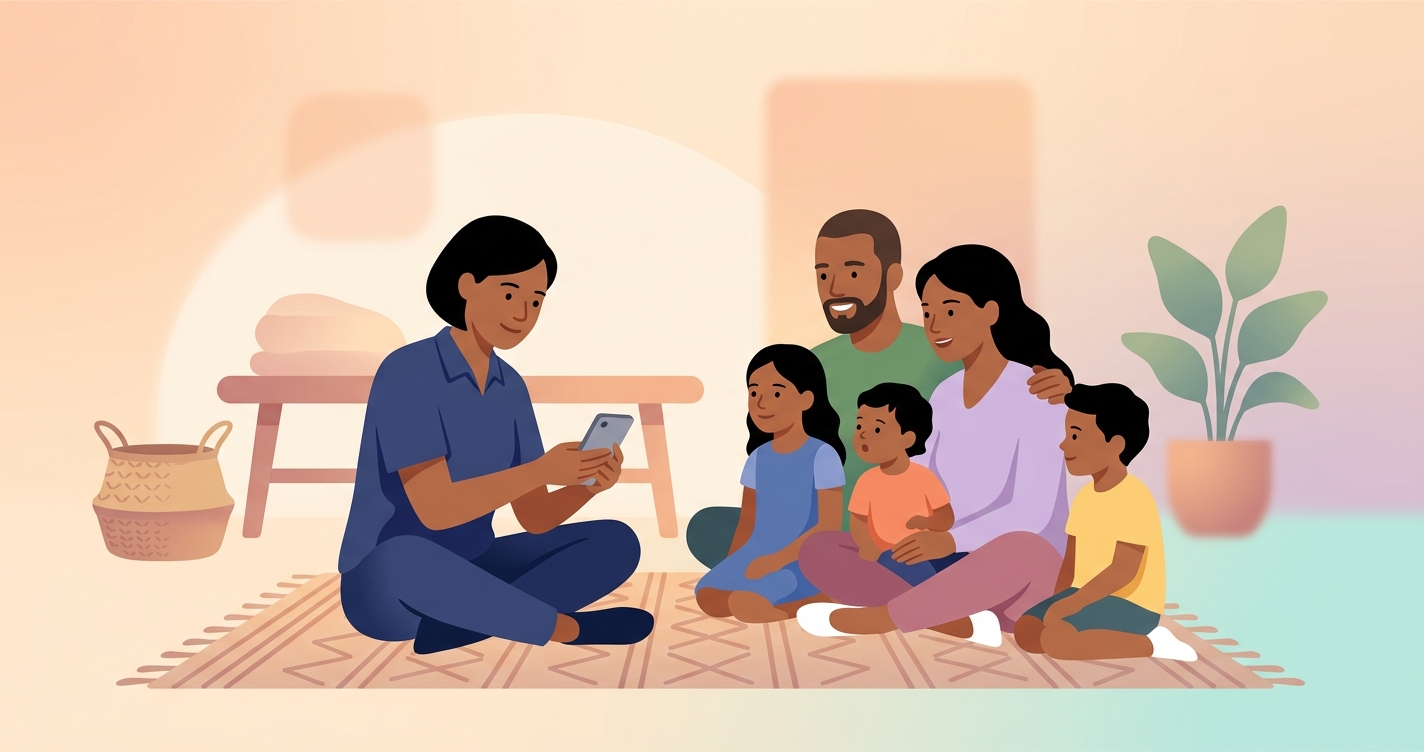
Picture a community health worker sitting on a low wooden bench inside a homestead, a single charged smartphone in hand, recording structured vital-sign readings for a grandmother, two parents, and four children in the time it once took to unwrap a blood pressure cuff. That scene is no longer hypothetical, and it is quietly changing how funders and researchers think about community health program outcomes. When screening becomes portable enough to reach an entire household in one visit, the unit of measurement shifts from the individual patient to the family, and the evidence base for population-scale prevention changes with it.
For public health institutions and grant-making bodies, the question is not whether a phone can capture a heart rate. It is whether household-level screening produces measurable, attributable, fundable improvements in coverage, early detection, and follow-through.
A February 2024 systematic review and meta-analysis found that mHealth interventions delivered by community health workers more than doubled childhood vaccination rates across studied programs in Africa, one of the clearest signals yet that mobile screening and follow-up translate into measurable population outcomes.
Why family-level screening reshapes community health program outcomes
Traditional program evaluation has long treated the screened individual as the atomic unit. A woman attends an antenatal visit, a child is weighed, a man has his blood pressure checked. But disease risk clusters inside households. Hypertension, undernutrition, infectious exposure, and missed immunizations frequently travel together within a single roof. Screening one person at a time means the program sees fragments of a risk picture that is fundamentally collective.
Phone-based contactless screening compresses the cost and time of capturing a reading to the point where screening every member present becomes practical. This is the operational change that moves community health program outcomes from anecdote toward attributable effect. When a health worker can register and screen a whole family in a single sitting, three things happen that matter to evaluators:
- Coverage rises because the marginal cost of screening an additional household member approaches zero.
- Early detection improves because asymptomatic relatives who would never have presented at a clinic are captured passively.
- Referral completion becomes traceable at the household level, letting analysts follow whether a flagged reading actually led to care.
The result is a richer denominator. Instead of reporting how many individuals were touched, programs can report how many families were fully screened, a metric that maps more closely to the way risk and behavior actually operate.
A comparison of screening models and their measurable outcomes
The table below contrasts three screening approaches that public health teams commonly evaluate, focusing on the outcome dimensions that grant reviewers tend to scrutinize.
| Dimension | Clinic-based individual screening | Door-to-door paper survey | Phone-based family screening |
|---|---|---|---|
| People reached per worker-day | Low to moderate | Moderate | High |
| Household coverage | Fragmentary | Variable | Whole-family in one visit |
| Data quality and structure | High but siloed | Often incomplete | Structured, timestamped, geotagged |
| Cost per additional family member | High | Moderate | Near zero |
| Referral traceability | Weak across members | Weak | Linkable across the household |
| Equipment dependency | High (cuffs, monitors) | Low | Smartphone only |
| Suitability for longitudinal follow-up | Limited | Limited | Strong |
No single model dominates every context. Clinic screening remains the reference standard for diagnostic confirmation. But for breadth, cost efficiency, and the kind of structured longitudinal data that funders increasingly require, household phone screening occupies a distinct and defensible position.
Industry applications across the global health sector
Maternal and child health programs
The strongest documented outcomes for mobile screening sit in maternal and child health. Reviews of community health worker mHealth deployments in sub-Saharan Africa consistently report increases in antenatal care attendance and facility-based births. When a health worker screening a pregnant woman can, in the same visit, weigh her children and flag the family's other adults, the program converts a single touchpoint into a household intervention. For child health specifically, the vaccination outcome data is among the most robust in the literature.
Non-communicable disease surveillance
Hypertension and other cardiovascular risks are notoriously underdiagnosed in rural populations because they are asymptomatic until late. Family screening surfaces these silent cases at scale. A program that screens every adult present in a household, rather than only the person who came forward, casts a wider net for exactly the conditions that benefit most from early detection.
Grant evaluation and impact reporting
For grant-making bodies, the appeal is evidentiary. Structured, timestamped readings captured across a defined household population produce the denominators and follow-up chains that rigorous impact evaluation demands. This is where global health technology impact becomes legible to a finance committee rather than remaining a field anecdote.
Current research and evidence
The technical foundation for phone screening rests on remote photoplethysmography (rPPG), which estimates pulse and related vitals from subtle color changes in skin captured by a camera. Validation work has matured quickly. A clinical validation study of rPPG-enabled contactless pulse rate monitoring in cardiovascular disease patients reported strong agreement with ECG, with a mean absolute error near 1.06 beats per minute. A separate evaluation of a smartphone rPPG application reported heart rate accuracy above 97 percent with a relative mean absolute percentage error of roughly 2.66 percent in normotensive adults.
These accuracy figures matter because screening outcomes are only as credible as the readings behind them. A 2024 scoping review of smartphone photoplethysmography for resting heart rate concluded that, under appropriate acquisition conditions, agreement with electrocardiography ranges from good to very strong in healthy subjects, while also stressing the need for standardized acquisition and reporting protocols. That caveat is the honest center of the evidence: accuracy depends on conditions, and field deployment introduces motion, lighting, and skin-tone variability that laboratory studies must account for.
On the program side, the mHealth literature is increasingly consistent. The February 2024 meta-analysis on childhood vaccination found that mobile-supported community health worker programs more than doubled immunization rates, while broader reviews of maternal mHealth in sub-Saharan Africa point to improved antenatal care use and facility delivery. The recurring theme across this body of work is that technology alone does not produce outcomes. Sociocultural alignment, community trust, health worker training, and mentorship determine whether a tool delivers. The strongest programs treat the phone as one input within a human-centered system rather than as the intervention itself.
The future of family health screening
Three developments are likely to define the next phase. First, expansion of the vital-sign panel: as rPPG and related camera methods extend beyond heart rate toward respiration and other indicators, a single household visit can characterize more dimensions of risk. Second, longitudinal household records: because phone screening is cheap to repeat, programs can build family-level time series that reveal trajectories rather than snapshots, which is precisely what evaluators need to demonstrate sustained effect. Third, integration with national surveillance, where anonymized household screening data flows upward to inform district and national resource allocation.
The constraint that will shape all three is evidentiary discipline. Funders are right to demand standardized acquisition protocols, transparent reporting of accuracy across skin tones and field conditions, and clear referral-completion metrics. The programs that pair convenient family screening with this rigor are the ones that will turn a compelling field story into durable community health program outcomes.
Frequently asked questions
Can a phone really screen an entire family accurately enough to be useful?
Phone-based rPPG has shown strong agreement with reference instruments for heart rate in validation studies, with reported errors around 1 to 3 beats per minute under good conditions. For population screening, the goal is reliable triage and early detection rather than diagnosis, so this level of accuracy supports flagging at-risk household members for clinical follow-up, provided acquisition conditions are controlled.
What outcomes can funders actually measure from family screening programs?
Evaluators can track whole-family screening coverage, early-detection rates for conditions like hypertension, referral completion across household members, and longitudinal changes in repeat visits. Published mHealth evidence also links community health worker programs to higher vaccination and antenatal care rates, which serve as established outcome benchmarks.
Does the technology work across different skin tones and field conditions?
This is an active research priority. Camera-based methods can be sensitive to lighting, motion, and skin pigmentation, so credible programs report accuracy stratified by these factors and follow standardized acquisition protocols. The current literature emphasizes that transparent, condition-specific reporting is essential to trustworthy results.
How does household screening differ from screening individuals at a clinic?
Clinic screening confirms diagnoses but reaches only those who present. Household screening captures asymptomatic relatives, lowers the marginal cost per additional person, and produces structured data linkable across a family, making it better suited to coverage, early detection, and longitudinal evaluation.
Circadify is working in this space alongside researchers and public health institutions to document field deployment results and strengthen the evidence base for household-level screening. Teams evaluating intervention effectiveness or exploring collaboration can review the research and program writing at circadify.com/blog.