How can a remote village clinic track heart health without machines?
How contactless vitals community health programs let village clinics track heart rate and rhythm using a phone camera, with field outcomes from low-resource settings.
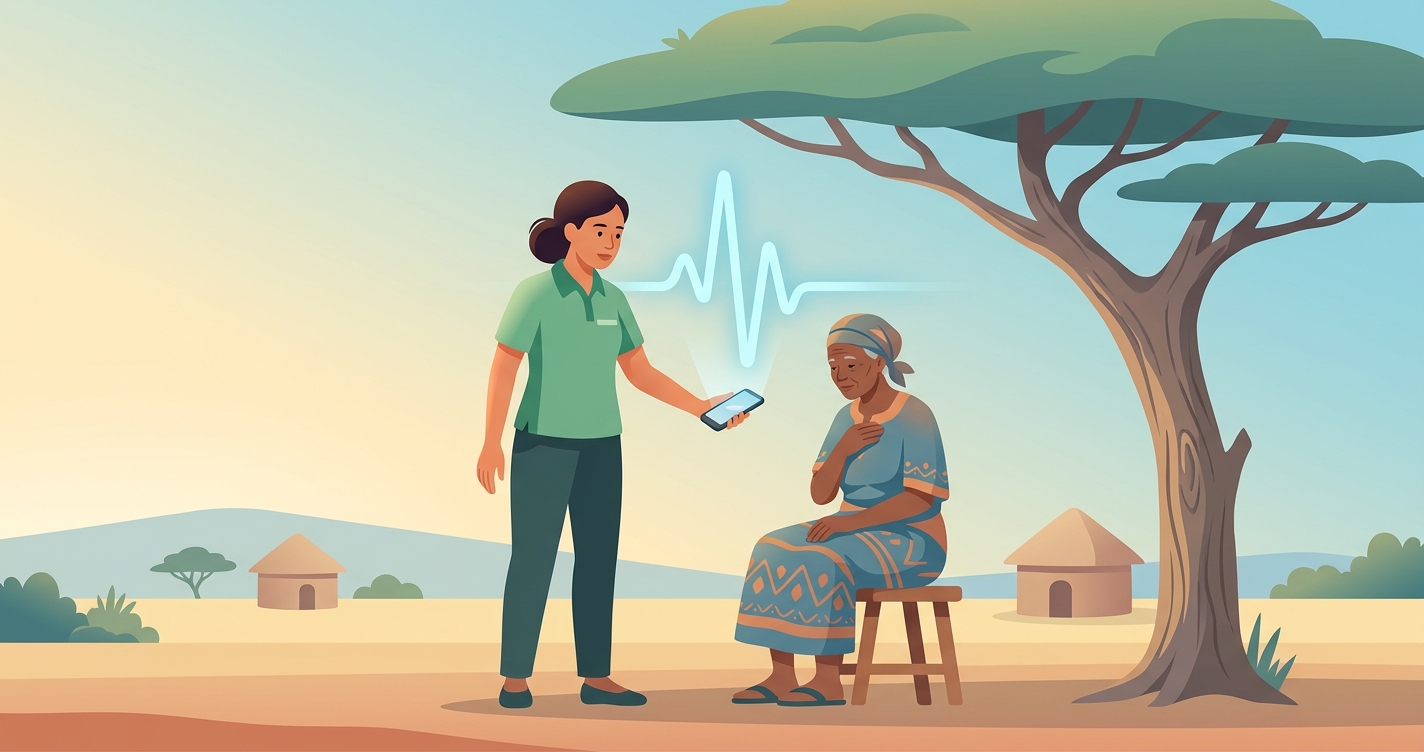
A district health team can now register, screen, and triage several hundred people on a market day in a village with no electricity grid, no blood pressure cuff inventory, and no functioning electrocardiogram within a two-hour drive. The instrument doing the work is the same smartphone the health worker already carries. This shift, built on contactless vitals community health methods, is changing what a remote clinic can reasonably be expected to detect, and it is doing so without the procurement, calibration, and maintenance burdens that have stalled medical device programs in low-resource regions for decades.
The relevant technology is remote photoplethysmography, usually shortened to rPPG. A standard camera records subtle color changes in facial skin as blood pulses through capillaries with each heartbeat. Signal processing and machine learning models convert those micro-changes into a heart rate, and increasingly a heart rhythm signal, without anything touching the patient. For a clinic that has never owned a working monitor, the question is no longer whether the hardware exists, but whether the measurement is good enough to act on in the field.
In a smartphone camera heart rate validation reported by Google Research in 2024, the passive monitoring system reached a mean absolute percentage error of 6.09 percent and a mean absolute error of 4.39 beats per minute, accuracy the authors described as comparable to consumer wearable trackers.
What contactless vitals community health programs actually measure
The phrase contactless vitals community health describes a workflow more than a single device. A community health worker opens an application, positions the phone so the camera sees the patient's face or fingertip for roughly 30 to 60 seconds, and the software returns estimated vital signs. Heart rate is the most mature output. Respiratory rate, derived from chest and shoulder motion or from variation in the pulse signal, is commonly included. Some systems estimate oxygen saturation and provide a screening-level read on heart rhythm irregularity, which is the signal most relevant to detecting atrial fibrillation and other arrhythmias that often go unrecognized in rural populations.
What the method does not do is replace a diagnosis. It produces a structured, time-stamped, geotagged record that flags who needs escalation. In settings where the alternative is no measurement at all, that triage value is the point. The technology converts a subjective impression of who looks unwell into a dataset a district office can audit, aggregate, and act on.
Three constraints shape every honest discussion of this approach:
- Motion and lighting degrade the signal. A crying infant or harsh midday sun introduces artifacts that contact sensors avoid.
- Skin tone representation in training data has historically been poor, which makes validation across darker skin tones a non-negotiable requirement for African deployments.
- The output is a screening estimate, not a clinical-grade continuous monitor, and program design has to treat it that way.
How the options compare for a village clinic
A clinic choosing how to track heart health is really comparing four realistic paths, not two. The table below sets out the practical trade-offs that matter to a program planner rather than a laboratory.
| Approach | Hardware cost per worker | Consumables and upkeep | Throughput on a screening day | Heart rhythm signal | Main field limitation |
|---|---|---|---|---|---|
| Manual pulse and clinical judgment | Near zero | None | Low | None | Subjective, no record |
| Aneroid or digital BP cuff plus stethoscope | Moderate | Cuffs degrade, need recalibration | Low to moderate | Limited | Stock-outs, drift, training |
| Wearable biosensor patch | Higher | Adhesives, charging, replacement sensors | Moderate | Yes, continuous | Connectivity and adhesion failures |
| Contactless rPPG on existing phone | Near zero (uses owned device) | None beyond charging | High | Screening-level | Motion, lighting, skin-tone validation |
The economic case is clearest in the final row. Because the camera is already in the worker's pocket, the marginal cost of adding heart rate screening to an existing community health worker visit approaches zero. That changes the unit economics of population screening from a procurement problem into a software and training problem.
Industry applications in low-resource settings
Hypertension and cardiovascular triage
Cardiovascular disease is rising fast across sub-Saharan Africa, often undetected until a stroke or cardiac event. A community health worker who can capture a heart rate and rhythm read at the doorstep gives the system a chance to catch tachycardia, bradycardia, or irregular rhythm before symptoms force a late, expensive hospital presentation. A trial in Uganda found that community health worker-led remote care improved blood pressure control to 86 percent of participants at 48 weeks, against 44 percent under standard clinic care, evidence that frontline workers paired with simple monitoring tools can move hard clinical endpoints.
Maternal and newborn screening
Antenatal visits are a natural insertion point. A contactless heart rate read for both mother and, with appropriate methods, newborn adds a vital sign to a visit that might otherwise capture only weight and a verbal symptom check. Programs report that adding a quick objective measurement raises the perceived value of the visit and supports referral decisions that are otherwise made on intuition.
Outbreak and acute illness surveillance
During acute illness, a rising heart rate and respiratory rate are early warning signs. Wearable biosensors were deployed to monitor Lassa fever patients in Sierra Leone, though investigators noted that sensor connectivity and skin adhesion problems degraded data quality. Contactless capture sidesteps the adhesion failure mode entirely, at the cost of being intermittent rather than continuous, a trade many field teams accept for screening at scale.
Current research and evidence
The accuracy literature has matured quickly. Beyond the Google Research 2024 passive monitoring results, validation studies of smartphone fingertip and facial photoplethysmography have reported resting heart rate estimates closely tracking electrocardiography references, with accuracy falling under motion and post-exercise conditions. A 2023 Frontiers scoping review of contact-based smartphone photoplethysmography concluded that resting heart rate can approach electrocardiography accuracy when acquisition is standardized, and it published a checklist for reporting, a sign the field is moving toward methodological discipline.
Acceptability evidence from Africa is also encouraging. A case study in Burkina Faso reported 94 to 100 percent acceptability for consumer-grade monitoring devices among rural participants, indicating that the social barrier to digital vital sign capture is lower than infrastructure assumptions often suggest. Device development work such as the neoGuard wireless vital signs monitor, designed with East African health worker feedback, has produced a parallel lesson worth heeding: tools survive the field only when they are built around the worker's actual workflow, power realities, and connectivity gaps.
The honest gap in the evidence is large-scale, head-to-head field validation of fully contactless methods specifically in community deployment, across diverse skin tones and uncontrolled lighting. Most rigorous accuracy data still comes from controlled or semi-controlled settings. Closing that gap is the central research opportunity for the next several years.
The future of contactless vitals community health
Three developments will define the next phase. First, skin-tone-balanced validation will become a publication and procurement requirement rather than an afterthought, which directly determines whether results from one region transfer to another. Second, on-device models will reduce dependence on connectivity, letting a phone compute vitals offline and sync later, which matches the reality of villages with intermittent signal. Third, integration with national surveillance systems will turn millions of individual screening records into population-level cardiovascular and febrile-illness signals, giving health ministries a near-real-time view they have never had.
For grant-making bodies and public health institutions, the practical implication is that the binding constraint is shifting from hardware to evidence and governance. The cameras are capable. The open questions are how to validate them fairly, how to embed them in referral pathways that actually move patients, and how to measure whether earlier detection changes outcomes. Those are program design and research questions, and they are answerable.
Frequently asked questions
Can a phone camera really measure heart rate accurately enough to be useful? For resting heart rate, validation studies including Google Research in 2024 report errors in the range of a few beats per minute, comparable to consumer wearables. Accuracy drops with motion and poor lighting, so field programs treat the output as a screening estimate that triggers escalation, not a diagnostic reading.
How does this work without electricity or internet? The measurement runs on a charged smartphone and increasingly can be computed on the device itself. Records sync to a central system when connectivity returns. Solar charging and offline-first application design make day-long screening campaigns feasible in villages with no grid power.
Does skin tone affect the results? It can. Earlier rPPG models were trained on limited skin-tone diversity, which produced uneven accuracy. Current best practice, and a requirement for credible African deployments, is validation across the full range of skin tones in the target population before scale-up.
What heart conditions can this catch in a village setting? Screening-level detection of abnormal heart rate, such as tachycardia or bradycardia, and irregular rhythm that may indicate arrhythmias like atrial fibrillation. The goal is to flag people for clinical follow-up earlier than symptom-driven presentation would.
Circadify is working in exactly this space, building and documenting contactless screening tools for community health worker deployments and publishing the field evidence that researchers and funders need to evaluate them. Explore the research papers and collaboration opportunities at circadify.com/blog.