Can a basic phone help a nurse identify sick people in a crowded market?
Field results on phone vital sign results in crowded markets: how rPPG screening helps nurses triage sick people fast in community health settings.
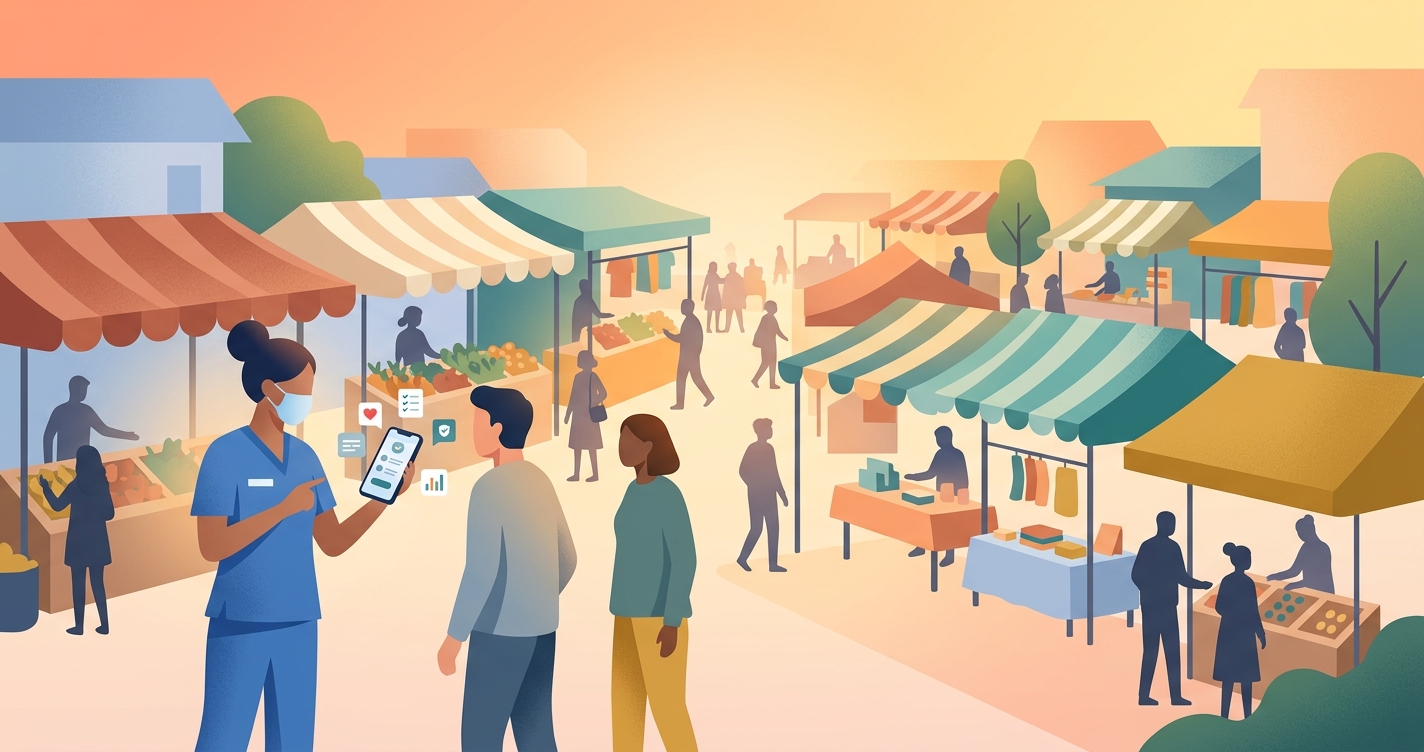
A market day in a district town is one of the hardest environments in global health. Hundreds of people pass through in a few hours, a single nurse may be the only clinically trained person present, and the traditional screening kit, a cuff, a pulse oximeter, a thermometer, and a paper register, moves at the speed of one person at a time. The practical question public health programs keep asking is whether phone vital sign results captured from a basic smartphone can change that arithmetic, letting a nurse separate the people who look fine from the few who quietly need urgent attention. Early field deployments suggest the answer is a qualified yes, with the qualifications mattering as much as the yes.
"In low-resource settings, an estimated 6 in 10 people who need essential health services never receive them, and screening capacity is a primary bottleneck.", World Health Organization, Universal Health Coverage data, 2023
What phone vital sign results actually mean in the field
The technology behind phone-based screening is remote photoplethysmography, or rPPG. A phone camera records subtle color changes in the skin of a person's face caused by blood flowing with each heartbeat. Signal processing converts those changes into estimates of heart rate, respiratory rate, and related cardiovascular indicators, with no contact and no consumable supplies. The method builds on work formalized by Wim Verkruysse and colleagues at the Philips Research lab in 2008, and later extended for motion-tolerant settings by Daniel McDuff and Ming-Zher Poh, whose 2010 and 2011 MIT Media Lab studies showed that an ordinary webcam could recover cardiac signals from a moving subject.
In a crowded market, the relevant question is not laboratory precision but triage value. A nurse does not need a diagnosis from a 30-second scan. She needs a defensible reason to pull one person out of a line of eighty for a closer look. Phone vital sign results function as a fast first filter, flagging elevated heart rate, irregular rhythm patterns, or abnormal respiratory rate so that the limited supply of cuffs and clinical time goes to the people most likely to need it.
Here is how the screening approaches compare in a high-throughput public setting:
| Screening approach | People per hour (1 worker) | Equipment cost | Consumables | Crowd/motion tolerance | Best use |
|---|---|---|---|---|---|
| Manual cuff + oximeter + thermometer | 8 to 15 | Moderate | Cuffs, probe covers | Low | Confirmatory measurement |
| Wearable patch distribution | 5 to 10 | High | Adhesives, batteries | Medium | Continuous monitoring |
| Phone rPPG scan | 30 to 60 | Low (existing phone) | None | Medium to high | First-pass triage |
| Visual/symptom-only check | 40 to 80 | None | None | High | Untriaged eyeballing |
The pattern field teams report is consistent:
- Throughput rises sharply when a phone scan replaces a cuff as the first touchpoint.
- Zero consumables removes a recurring supply-chain failure point in remote districts.
- The phone produces a structured digital record automatically, which paper registers do not.
- Confirmatory devices are still needed, but far fewer of them and used far less often.
Industry applications for public health programs
Market and gathering-point screening
Markets, places of worship, transport hubs, and food distribution points concentrate large numbers of people who rarely visit a clinic. Deploying a single nurse with a phone at these sites converts foot traffic into screening volume. In several community health worker programs across East Africa, market-day screening has become the highest-yield channel for finding undiagnosed hypertension and respiratory distress precisely because it reaches people who are not seeking care.
Outbreak and surge response
During suspected outbreaks, contact-based vitals create infection-control risk and slow lines to a crawl. Contactless phone vital sign results allow rapid, no-touch fever-adjacent and cardiorespiratory flagging at entry points, preserving protective equipment and reducing exposure for the screener.
Referral pathway activation
A flag is only useful if it leads somewhere. The strongest deployments link the phone result to a referral workflow, so a person identified as high-risk in a market receives a same-day note to the nearest facility. This is where screening volume converts into measured community health program outcomes rather than data that sits unused.
Current research and evidence
The evidence base for rPPG has matured from proof-of-concept to field evaluation. Building on the foundational MIT Media Lab work, a 2018 review by Daniel McDuff and Ethan Blackford catalogued the conditions, lighting, skin tone, and motion, that most affect signal quality, which directly shapes how programs should deploy phones in bright, busy outdoor markets. Subsequent work on skin-tone fairness, including studies led by groups examining camera-based vitals across diverse populations, has pushed developers to validate across the full range of complexions seen in African field settings rather than on narrow samples.
Field deployment results reported by community health programs add the operational layer that lab studies cannot. Across large screening drives, the most informative metric is not a single device specification but the agreement between a phone first-pass flag and a confirmatory cuff reading. Programs typically track three things:
- Sensitivity for triage: how often the phone flags people whom confirmatory measurement also classifies as elevated.
- False-flag burden: how many extra confirmatory checks the workflow generates per real case found.
- Throughput gain: net additional people screened per worker per day versus the manual baseline.
The honest reading of current evidence is that phone rPPG performs well as a screening filter under cooperative conditions and degrades with heavy motion, poor lighting, and very short capture windows. For market deployment, the design response is short stabilized capture, shade where possible, and a clear rule that any flag triggers a confirmatory measurement. Used that way, the phone extends a nurse's reach without asking the result to do more than it can.
A 2021 review in the journal Sensors by researchers studying camera-based physiological measurement reached a similar conclusion: the technology is ready for screening and triage roles, while clinical-grade replacement of validated devices remains a research frontier rather than a present claim.
The future of phone-based market screening
Three directions are likely to define the next several years of deployment. First, on-device processing will reduce dependence on connectivity, letting results compute on the phone itself in markets with no signal. Second, integration with referral and registry systems will turn isolated scans into longitudinal records, so a person screened at a market in March is recognizable when they appear at a clinic in June. Third, fairness validation across skin tones and field conditions will move from optional to expected by grant-making bodies, which increasingly require disaggregated performance data before funding scale-up.
The strategic value for public health institutions is not that a phone replaces clinical judgment. It is that a single trained nurse, equipped with a tool already in her pocket, can credibly screen ten times as many people in a crowded space and direct scarce confirmatory resources to the few who need them. That is a structural change in screening economics, and it is why funders are watching field deployment results closely.
Frequently asked questions
Can a basic smartphone really capture vital signs without any attachment? Yes, through remote photoplethysmography. The camera detects small color changes in facial skin tied to blood flow and converts them into heart rate and respiratory estimates. No cuff, probe, or attachment is required, though good lighting and a brief still capture improve signal quality.
Are phone vital sign results reliable enough to make decisions in a crowded market? They are best treated as a triage filter rather than a final measurement. In field deployments they help a nurse decide who needs a confirmatory cuff or oximeter check. Any flagged result should be confirmed before clinical action, which is the standard most programs adopt.
What conditions degrade phone-based screening in the field? Heavy body motion, direct harsh sunlight, very short capture windows, and unvalidated performance across skin tones are the main factors. Programs mitigate these with shaded stations, short stabilized scans, and tools validated across diverse populations.
How does this affect screening throughput for one health worker? Manual vitals typically allow 8 to 15 people per hour, while a phone first-pass scan can reach 30 to 60, freeing confirmatory equipment for the smaller number of flagged cases.
Circadify is working on contactless, phone-based screening tools built for exactly these high-throughput community settings, and we publish field methodology and program outcomes for researchers and funders evaluating scalable approaches. Read our research and explore collaboration at circadify.com/blog.