
Phone Screening vs Clinic Equipment: Which Catches More Cases?
A head-to-head review of phone screening vs clinic equipment on detection rates, sensitivity, and cost for public health evaluators planning procurement.
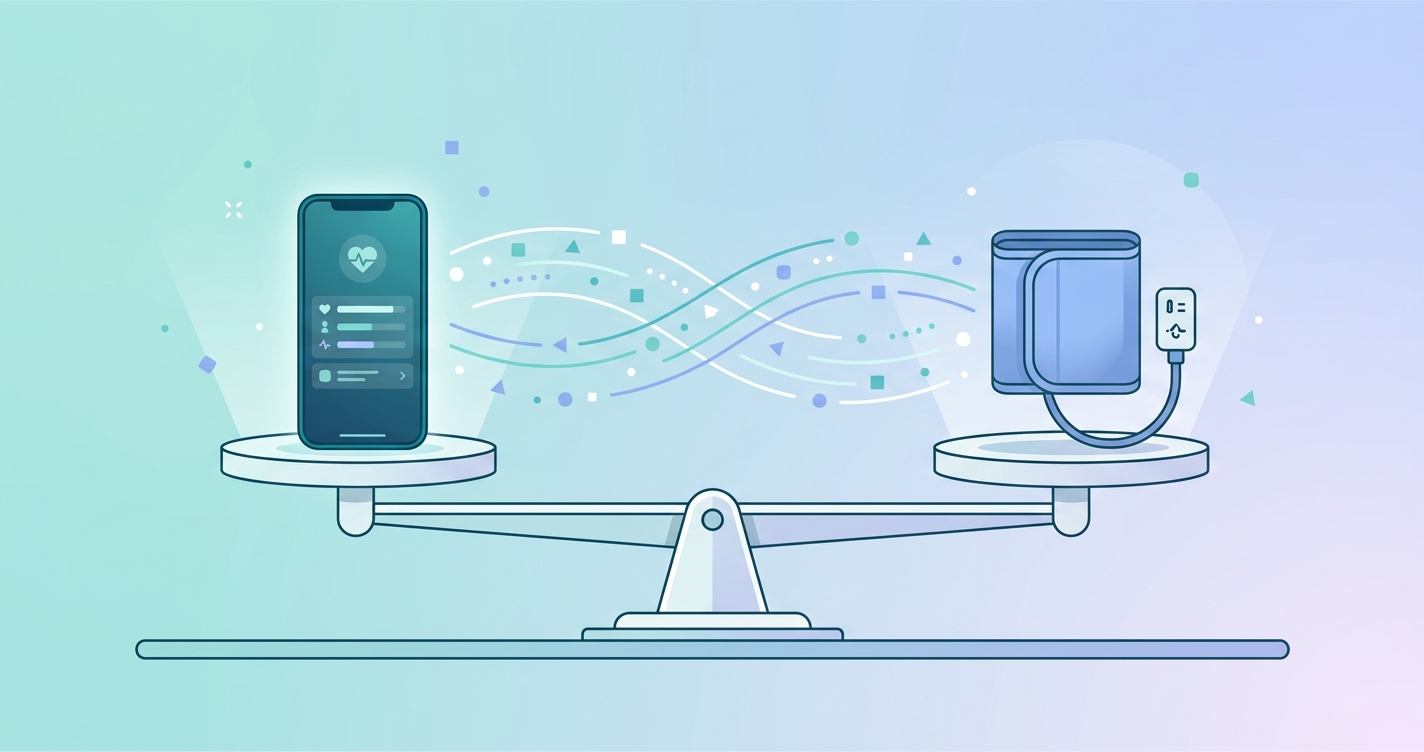
Procurement committees inside public health institutions are being asked a question that did not exist five years ago: should a screening program buy a fleet of validated medical monitors, or equip community health workers with software that turns existing smartphones into measurement tools? The decision is no longer abstract. With non-communicable disease screening expanding across low-resource districts, the comparison of phone screening vs clinic equipment now drives real budget lines, coverage targets, and the number of undiagnosed cases a program can realistically find. The honest answer is that the two approaches do not compete on a single axis. They differ on accuracy, throughput, reach, and cost per case detected, and the right tool depends on which of those an evaluator weighs most heavily.
A mobile health unit study across socially vulnerable communities in Detroit found that 42 percent of participants had undiagnosed hypertension or were unaware of their blood pressure status, a reminder that the largest gains in screening come from reaching people who never enter a clinic at all.
Phone screening vs clinic equipment: what the numbers actually compare
When evaluators frame phone screening vs clinic equipment, they are usually comparing two distinct things: per-reading accuracy and population-level case detection. Clinic equipment, meaning validated automated cuffs, pulse oximeters, and ECG monitors, sets the accuracy benchmark. Phone-based screening, typically built on remote photoplethysmography (rPPG) or contact PPG through the camera, trades a margin of per-reading precision for speed, scale, and the ability to operate where no device or clinic exists.
The accuracy gap is real but uneven across vitals. Heart rate from smartphone PPG tracks clinical reference standards closely. A 2024 scoping review in Frontiers in Digital Health on contact-based smartphone photoplethysmography reported strong agreement with electrocardiography for resting heart rate under good acquisition conditions. A 562-participant evaluation of a non-contact PPG mobile application found heart rate accuracy near 99 percent and SpO2 accuracy around 93 percent, while systolic and diastolic blood pressure estimates were far more moderate at roughly 61 and 56 percent. Blood pressure remains the hardest case for camera-based methods, with reported mean absolute errors near 6.7 mmHg systolic and 9.6 mmHg diastolic in some frameworks.
That is the per-reading story. The case-detection story looks different, because detection depends on how many people you measure, not only on how precise each measurement is.
| Dimension | Phone-based screening | Conventional clinic equipment |
|---|---|---|
| Heart rate accuracy | High agreement with ECG in good conditions | Reference standard |
| Blood pressure accuracy | Moderate; estimation-based, improving | Reference standard (validated cuff) |
| Throughput per worker | High; 30 to 60 second captures | Lower; cuff inflation and reset time |
| Geographic reach | Anywhere a phone reaches | Limited to device and clinic locations |
| Hardware cost per unit | Marginal; uses existing phones | Recurring per device plus consumables |
| Maintenance and calibration | Software updates | Cuff replacement, calibration, batteries |
| Best role | First-pass population screening | Confirmation and diagnosis |
The pattern that emerges from field economics is consistent. Phone screening tends to win on cost per person reached and cases surfaced, while clinic equipment wins on confirmatory accuracy. A 2023 systematic review of economic evidence on community hypertension interventions concluded that decentralized, lower-cost monitoring strategies are generally the most cost-effective long-term approach compared with traditional clinic-only monitoring.
Key trade-offs evaluators should hold in view:
- A screening tool that reaches twice as many people at slightly lower per-reading precision can still detect more true cases than a precise tool that reaches half as many.
- Blood pressure is the weakest link for camera-based vitals, so programs targeting hypertension specifically need a confirmation pathway with a validated cuff.
- Clinic equipment carries recurring costs that phone software does not: cuffs, calibration, batteries, and replacement.
- Throughput matters in market-day screening, where one cuff and one queue limits how many people a worker can process before fatigue and crowding cut the session short.
Industry Applications
Mass first-pass screening
The strongest case for mobile screening versus traditional devices is population-level triage. When the goal is to flag who needs a closer look, a 30 to 60 second phone capture lets a single worker process dozens of people in the time a cuff-based station handles a handful. Kiosk and self-measured programs already show the value of high sensitivity at this stage; community kiosk screening has reported sensitivity up to 96 percent for detecting elevated blood pressure, accepting lower specificity because the design intent is to catch, not confirm. Phone screening extends that logic to places kiosks cannot go.
Confirmation and diagnosis
Conventional clinic equipment keeps its decisive role at the confirmation step. A flagged reading from any first-pass tool, phone or kiosk, should route to a validated cuff or clinical device before treatment decisions follow. Home blood pressure monitoring, by comparison, has shown sensitivity around 82 percent and specificity around 53 percent against ambulatory monitoring, which is why diagnosis still rests on reference-grade measurement. The two tiers are complementary, not interchangeable.
Procurement and coverage planning
For evaluators, the low-cost screening comparison reframes the budget question. Instead of asking which device is most accurate, the operational question becomes: which mix of tools detects the most true cases per dollar across the whole catchment population? In districts where phones already outnumber medical devices by a wide margin, a phone-led first pass with a smaller pool of validated confirmation devices often dominates a device-only plan on cost per case detected.
Current research and evidence
The evidence base for phone vitals vs medical monitors is maturing quickly. Regulatory progress signals growing confidence in camera-based measurement: a smartphone rPPG application from Lifelight received Class II medical certification for blood pressure measurement using only a phone camera, with AI models trained on more than 25,000 paired video and gold-standard recordings from roughly 12,500 patients. Clinical validation work published in MDPI journals has examined rPPG-enabled contactless pulse rate monitoring in cardiovascular disease patients, and a community validation trial registered on ClinicalTrials.gov is testing rPPG-derived cardiovascular parameters against standard clinical measurements and risk scores.
On the cost side, the direction of findings is steady. Community-based and self-measured programs have been linked to a 12.3 percent improvement in blood pressure control rates from 2020 to 2022, and mobile clinics have been associated with cost savings through reduced emergency department use. The cost-utility analysis of home blood pressure measurement delivered through village health volunteers in Thailand, published in PLOS One, adds a low-resource data point showing that decentralized measurement can be economically favorable.
What the literature does not yet fully settle is real-world performance across skin tones, motion, lighting, and the specific conditions of outdoor community screening. Most accuracy figures come from controlled settings. Field deployment data, the kind generated by community health worker programs operating outside laboratory conditions, is the missing layer that procurement decisions most need.
The future of phone screening vs clinic equipment
The framing is shifting from rivalry to layered systems. The likely near-term model is a tiered screening architecture: phone-based first-pass capture for reach and throughput, validated devices reserved for confirmation, and shared digital records linking the two so a flagged person is tracked through to diagnosis. As rPPG blood pressure estimation continues to narrow its error margins and regulatory recognition broadens, the phone tier will absorb more of the screening burden, freeing scarce clinical devices for confirmation and follow-up.
For public health institutions, the practical frontier is evidence standardization. Procurement decisions improve when programs report detection rates, false-positive burden, referral completion, and cost per confirmed case using consistent definitions. That comparability, more than any single accuracy figure, will determine which tools earn a place in national screening budgets.
Frequently asked questions
Does phone screening detect more cases than clinic equipment? Not because it is more accurate per reading, but because it can measure more people. In populations where many never reach a clinic, a faster, more reachable tool can surface more true cases overall, even with a modest per-reading accuracy gap. Detection is a function of coverage multiplied by accuracy, not accuracy alone.
Is blood pressure reliable from a phone camera? It is the weakest vital for camera-based methods. Heart rate tracks clinical references closely, but blood pressure estimates carry larger errors. Phone screening is best used to flag likely cases, with a validated cuff confirming before any treatment decision.
Which is cheaper for a public health program? Phone-based screening generally has lower marginal cost because it uses existing devices and avoids recurring consumables like cuffs and calibration. Multiple economic reviews find decentralized, lower-cost monitoring more cost-effective long-term than clinic-only approaches, though confirmation devices remain a necessary budget line.
Should a program choose one or the other? Most evidence points to a tiered model rather than a single choice. Phone screening handles first-pass reach and throughput; clinic equipment confirms flagged cases. The two together usually outperform either alone on cost per confirmed case.
Circadify is working on this question directly, building field evidence on contactless screening performance and cost in community deployments rather than laboratory conditions. Public health institutions and evaluators weighing procurement can review the research and explore collaboration through our research and program evidence library.