How Mothers in Uganda Experience Prenatal Health Screening
An evidence-based look at how mothers in Uganda experience prenatal health screening, from antenatal contacts and CHW outreach to digital tools in rural care.
How Mothers in Uganda Experience Prenatal Health Screening
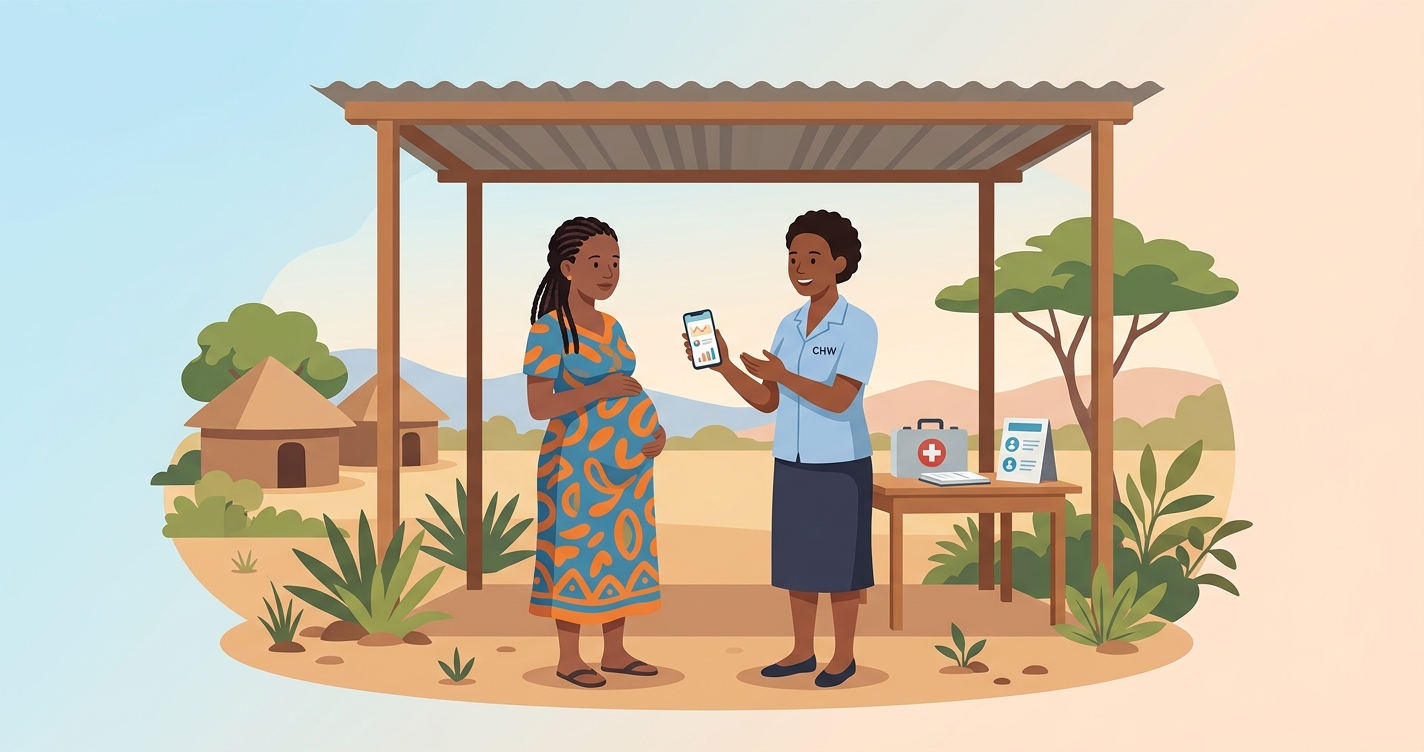
For many mothers in Uganda, prenatal health screening is not a single clinic appointment. It is a chain of moments: a first conversation with a village health team member, a blood pressure check at a health center, a crowded motorcycle ride for follow-up care, and, in some districts, an early experiment with smartphone-based screening that tries to bring more of that process closer to home. Mothers Uganda prenatal health screening experiences are shaped as much by distance, trust, and timing as by formal clinical protocols. That is exactly why researchers and grant-makers keep returning to Uganda when they study how maternal care systems can expand without losing quality.
"The intervention significantly improved pregnant women's knowledge, positive attitudes, and antenatal care attendance." — Juliet Nambooze and colleagues, cluster-randomized trial in eastern Uganda, BMC Public Health (2023)
Mothers Uganda Prenatal Health Screening: What the Care Pathway Actually Looks Like
Uganda has made real progress on antenatal care access, but the experience still varies sharply by district. The 2022 Uganda Demographic and Health Survey reported that 98% of women received antenatal care from a skilled provider, 97% had at least four antenatal visits, and 49% reached the newer benchmark of eight or more contacts. Those are encouraging numbers, though they also show how difficult it remains to move from initial access to continuity.
UNICEF Uganda's current antenatal care guidance mirrors the World Health Organization recommendation of eight contacts during pregnancy. In practice, those contacts are expected to cover blood pressure measurement, urine and blood testing, tetanus immunization, counseling, fetal position checks, and screening for conditions such as anemia, malaria, HIV, and sexually transmitted infections. For mothers, though, the experience is rarely that tidy. The formal checklist meets a health system that still struggles with transport costs, staff shortages, late presentation to care, and uneven referral follow-through.
Community health workers often sit in the middle of that gap. In eastern Uganda, community-based maternal and newborn programs described by Henry K. Waiswa and colleagues showed that trained village health workers improved maternal-newborn knowledge and helped push demand for facility services upward, especially where household visits were consistent. A separate 2023 cluster-randomized trial led by Juliet Nambooze found that community health worker-led education improved knowledge, attitudes, and antenatal care attendance among pregnant women in eastern Uganda.
Comparison of Prenatal Screening Touchpoints in Uganda
| Screening touchpoint | What mothers usually receive | Common friction point | Why it matters for outcomes |
|---|---|---|---|
| Community outreach visit | Pregnancy counseling, danger-sign education, referral encouragement | Irregular visit schedules, volunteer workload | Often determines whether a mother enters care early |
| First ANC clinic visit | History, blood pressure, basic lab screening, counseling | Late first visit, transport costs, queue times | Sets baseline risk profile for the pregnancy |
| Follow-up ANC contacts | Repeat screening, fetal monitoring, infection and anemia checks | Missed return visits, household demands, costs | Continuity is where risk trends become visible |
| Referral to higher-level facility | Evaluation of hypertension, bleeding, infection, or fetal concerns | Travel distance, delayed transport, family finances | Delays can turn manageable findings into emergencies |
| Pilot digital or smartphone-supported screening | Faster capture of selected vitals, digital record, triage support | Device availability, training, connectivity | Can reduce dependence on paper and help spot deterioration earlier |
What Mothers Report About the Experience
Qualitative work helps explain why headline coverage numbers do not tell the whole story. In a Ugandan community study on antenatal care viewpoints, pregnant mothers and community health workers described a familiar mix of motivations and obstacles: mothers understood the value of checkups, but practical barriers kept interfering. Transport money mattered. So did whether the nearest facility felt welcoming. So did whether a husband or elder relative supported repeat visits.
A useful way to read these findings is to separate three parts of the maternal screening experience:
- Recognition: Does a mother understand why early screening matters, even if she feels well?
- Access: Can she get to a provider without losing a day's wages or childcare support?
- Follow-through: Will she return enough times for screening to become longitudinal rather than one-off?
That last point matters more than it first appears. Prenatal screening is valuable because it catches change over time. A single normal visit does not rule out later hypertension, infection, or nutritional decline. Researchers studying Uganda's maternal care pathways keep finding that continuity, not just first contact, is where the system either holds together or starts to fray.
Where Community-Based and Contactless Screening Fit
Uganda has become a serious proving ground for community-linked digital health models. Some of the strongest current evidence is not about replacing clinics. It is about giving frontline workers better tools to identify which mothers need faster evaluation.
That makes contactless and smartphone-based screening interesting in this setting. In rural or peri-urban districts, any tool that shortens the distance between household observation and actionable referral can change the experience of care. A smartphone-based workflow can potentially support respiratory or pulse-related screening, create a cleaner digital trail than paper notes, and reduce the lag between detection and supervision. The case for these systems is not that they magically solve maternal mortality. It is that they may make routine screening more consistent where the ordinary system is stretched thin.
Existing research on community maternal health programs in eastern Uganda points in the same direction. When community workers are trained, supervised, and connected to facility-based care, mothers tend to receive better information earlier. The next step is making those interactions more measurable.
Practical situations where better screening changes the mother's experience
- A mother with swelling and headaches may be referred sooner when community outreach identifies danger signs before the next scheduled clinic day.
- A pregnant woman who lives far from the facility may benefit when repeat community touchpoints reduce the number of missed follow-up contacts.
- A district team may see referral bottlenecks faster when screening data is digitized instead of aggregated weeks later.
- Research programs can evaluate what is actually happening in pregnancy pathways when household-level observations become structured data.
Industry Applications and Program Design Implications
For academic researchers
Uganda offers a strong environment for studying how prenatal screening behaves outside tertiary hospitals. The combination of high antenatal contact coverage, active village health worker networks, and uneven rural access creates a realistic field setting for implementation research. That is especially useful for scholars comparing process metrics such as time to first visit, completion of repeat contacts, and referral completion.
For public health institutions
The operational question is not whether prenatal screening should happen. It already does. The real question is how to reduce drop-off between household awareness, primary facility assessment, and higher-level referral. Programs that strengthen community follow-up, transport coordination, and simple digital documentation may have more impact than programs that focus only on one isolated technology layer.
For grant-making bodies
Funders evaluating maternal health programs in Uganda should look beyond raw attendance counts. Stronger indicators include:
- proportion of women starting ANC in the first trimester
- proportion completing repeated contacts after the first visit
- time from danger-sign identification to facility review
- referral completion rates
- data completeness at community and facility levels
These are the metrics that show whether prenatal health screening is functioning as a system rather than as a reporting exercise.
Current Research and Evidence
Several studies help frame the evidence base around mothers' prenatal screening experience in Uganda.
First, the 2022 Uganda Demographic and Health Survey provides the clearest national benchmark: 98% of women received ANC from a skilled provider, 97% had at least four visits, and 49% achieved eight or more contacts. That gap between four visits and eight contacts captures the present transition in maternal care standards.
Second, Juliet Nambooze and colleagues published a 2023 cluster-randomized controlled trial in BMC Public Health showing that a community health worker-led education intervention improved knowledge, attitudes, and antenatal care attendance among pregnant women in eastern Uganda. That matters because it ties maternal screening performance to frontline communication, not only to facility capacity.
Third, Henry K. Waiswa and colleagues reported implementation and scale-up lessons from eastern Uganda showing that community health workers can improve maternal and newborn knowledge and stimulate demand for services when supervision and local integration are strong. It is an old lesson, but still an important one: community trust is infrastructure.
Fourth, UNICEF Uganda and the World Health Organization continue to frame eight antenatal contacts as the standard for a positive pregnancy experience, with repeated screening for maternal conditions and danger signs built into that model. The recommendation is global, but Uganda's challenge is intensely local: how to make eight meaningful contacts feasible for women whose pregnancies unfold far from high-capacity facilities.
The Future of Prenatal Health Screening in Uganda
The next few years will probably be defined less by new maternal care guidelines and more by execution. Uganda already has the policy language. The harder work is operational.
Three trends are worth watching.
First, community-linked screening is becoming more data-driven. Even modest digitization can help districts see where mothers are dropping out between first contact and referral completion.
Second, maternal screening is moving closer to the household. That does not eliminate the need for clinics, but it changes when risk is noticed.
Third, implementation research is getting sharper. More funders now want evidence on completion, timeliness, and real-world workflow performance, not just counts of women reached.
That is where solutions like Circadify fit into the broader conversation. The important point is not hype. It is that smartphone-based, low-friction screening tools are being developed for exactly the kinds of environments where maternal care pathways are still constrained by equipment, staffing, and distance. For readers following that evolution, the broader Circadify research blog tracks how contactless screening is being applied across community and field settings.
Frequently Asked Questions
How many antenatal visits do mothers in Uganda usually receive?
According to the 2022 Uganda Demographic and Health Survey, 97% of women had at least four antenatal visits, while 49% reached eight or more contacts. The shift toward eight contacts reflects current WHO guidance.
What is usually included in prenatal health screening in Uganda?
Routine antenatal screening typically includes blood pressure checks, urine and blood testing, tetanus immunization, fetal assessment, nutrition counseling, and screening for infections such as malaria, HIV, and sexually transmitted infections.
Why do some mothers still miss follow-up screening even when first-visit coverage is high?
The main reasons are practical: transport costs, long travel times, household responsibilities, delayed first presentation, and inconsistent follow-up support. High first-contact coverage does not automatically produce continuity.
What role do community health workers play in prenatal screening?
Community health workers help with early identification, counseling, danger-sign education, home visits, and referral encouragement. Research from eastern Uganda shows they can improve knowledge and antenatal attendance when properly trained and supervised.
Can smartphone-based screening replace antenatal clinics?
No. The more realistic role is support, not replacement. Smartphone-based and contactless tools may help identify risk earlier, improve documentation, and support triage in community settings, but mothers still need facility-based evaluation for diagnosis and treatment.
For related reporting from the same microsite, see Community Health Workers in Uganda: Stories From the Field and How Village Health Teams in Uganda Use Screening Technology.