Is it possible for health workers to quickly check vital signs with just a mobile phone in a remote village?
How mobile phone health checks rural programs use smartphone cameras to measure vital signs, with field evidence for researchers and public health institutions.
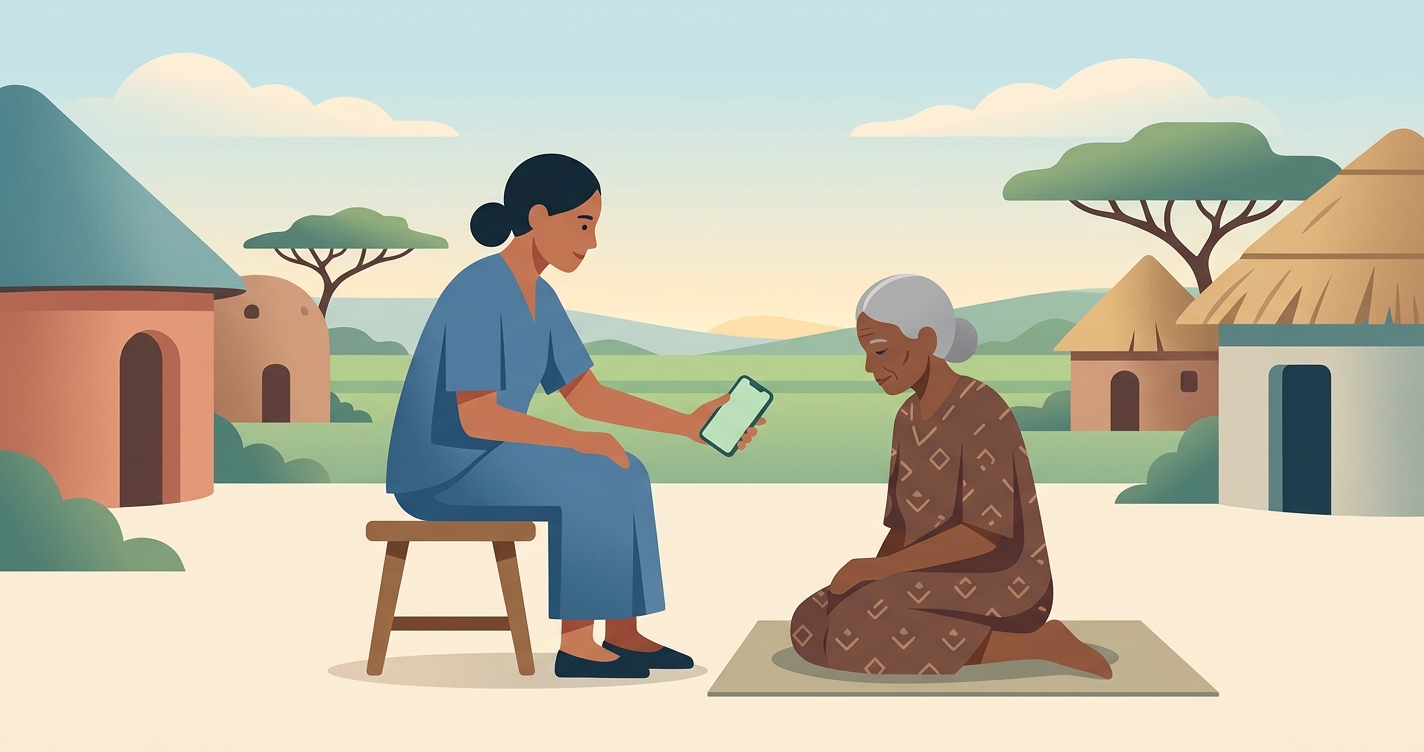
In a village three hours from the nearest district hospital, a community health worker holds up a smartphone, asks a mother to sit still for forty seconds, and reads back a heart rate. No cuff, no probe, no batteries to replace. This scene, increasingly common across rural East Africa, sits at the center of a practical question that researchers and program funders keep asking: can mobile phone health checks rural communities actually rely on deliver vital signs that are good enough to act on? The short answer emerging from field deployments is a qualified yes, and the qualifications are where the interesting science lives.
The mechanism is camera-based photoplethysmography, or rPPG. A phone camera detects the tiny color shifts in facial or fingertip skin caused by blood pulsing through capillaries. Signal-processing algorithms convert those shifts into heart rate and, in newer implementations, respiratory rate and other derived measures. Because the sensor is already in the worker's pocket, the marginal cost of a screening approaches zero.
A 2023 systematic review and meta-analysis of smartphone-based photoplethysmography reported a mean absolute error as low as 2.3 beats per minute and correlation coefficients reaching 0.99 against reference devices for heart rate measurement under controlled conditions.
Why mobile phone health checks rural programs scale faster than equipment
The core advantage is not novelty. It is the ratio of devices to people. In most of sub-Saharan Africa, mobile phone penetration has long outpaced the distribution of thermometers, pulse oximeters, and blood pressure cuffs. When the measuring instrument is the device a worker already carries and already knows how to charge, the logistics of a screening program change shape. There is no cold chain, no consumable cuff that wears out, no calibration trip back to the district office.
That shift matters most at the last mile, where traditional medical equipment is scarcest and where the people who most need screening are hardest to reach. A worker on foot can carry a clinic's worth of measurement capability without carrying any weight at all.
The trade-off is that a phone-based reading is a screening signal, not a diagnostic verdict. Its job is triage: flag the person who needs a referral, reassure the person who does not, and capture a data point that feeds a larger surveillance picture. Understanding where camera-based measurement is strong and where it is fragile is essential before any deployment.
| Factor | Smartphone camera (rPPG) | Dedicated medical device | Manual / clinical method |
|---|---|---|---|
| Upfront cost per worker | Near zero (existing phone) | Moderate to high per unit | Low but needs trained clinician |
| Consumables | None | Cuffs, probes, batteries | Minimal |
| Heart rate accuracy | High in controlled conditions (MAE ~2-3 bpm) | Reference-grade | Variable by operator |
| Vulnerability to motion | High | Low to moderate | Low |
| Skin tone sensitivity | Documented concern | Low | None |
| Training burden | Low | Moderate | High |
| Suitability for scale | Very high | Limited by procurement | Limited by staffing |
The honest reading of the table is that no single column wins on every row. The phone wins decisively on cost, consumables, and scalability. It loses on motion robustness and carries a documented sensitivity to skin tone and ambient light that any rigorous deployment must address head-on.
Key conditions that shape field reliability include:
- Ambient lighting, where harsh direct sun or deep shade both degrade signal quality
- Subject motion, the single largest source of measurement noise
- Skin tone, which affects the strength of the optical signal and demands inclusive algorithm validation
- Camera hardware variation across the many low-cost phone models used in the field
- Worker technique, especially framing, distance, and the instruction to hold still
Industry applications across community health programs
Maternal and antenatal screening
Routine vital-sign capture during antenatal visits helps identify pregnancies that need escalation. A phone-based check lets a worker record a resting heart rate during a home visit and log it against a woman's record, supporting continuity that a single annual clinic visit cannot provide.
Child and infant triage
Elevated heart and respiratory rates are early markers of infection in young children. For workers without a stethoscope or pulse oximeter, a camera-based estimate offers a structured prompt to refer rather than relying on visual impression alone.
Population-scale surveillance
Aggregated readings from hundreds of household visits build a district-level picture of population health that paper registers struggle to produce. The data flows upward, informing where to send scarce clinical resources.
Chronic and adult screening days
At market-day screening events, throughput is everything. A measurement that takes under a minute and requires no setup lets a small team screen far more people than a cuff-based station would allow.
Current research and evidence
The evidence base is maturing on two fronts. On accuracy, a 2023 systematic review and meta-analysis published in NPJ Digital Medicine and indexed through the US National Library of Medicine found that smartphone-based photoplethysmography can match medical-grade references for heart rate under controlled conditions, with mean absolute errors in the low single digits. A complementary 2022 meta-analysis in Frontiers in Cardiovascular Medicine reached similar conclusions while emphasizing that motion artifacts, ambient light, and skin tone remain the principal limits on real-world reliability.
On deployment, a 2023 systematic review in BMC Public Health on mobile health interventions across sub-Saharan Africa concluded that mHealth tools used by community health workers can improve care quality and enable faster, real-time data collection, while flagging infrastructure gaps, funding instability, and training needs as recurring obstacles. An earlier scoping review in Global Health Action documented the breadth of CHW phone use, from data collection to patient follow-up, across the continent.
The gap between the two literatures is the opportunity. Controlled accuracy studies rarely run in dusty courtyards under midday sun, and deployment studies rarely report instrument-level error against a gold standard. Closing that gap, by publishing field-grade accuracy data stratified by skin tone, lighting, and device, is the most valuable contribution the next wave of research can make.
The future of mobile phone health checks in rural settings
Three directions are likely to define the coming years. First, algorithmic robustness to motion and lighting will improve as models are trained on more diverse, field-collected data rather than clinic recordings. Second, the measurement set will expand cautiously beyond heart rate toward respiratory rate and other derived signals, each requiring its own validation rather than assumed transfer. Third, and most consequentially for funders, the field will move from asking whether the technology works in principle to asking how it performs across the specific populations and conditions where it is deployed.
That last shift favors programs that treat every screening as a data point worth auditing. The phones are already in the field. The unanswered questions are now empirical, not theoretical, and they are answerable by the kind of rigorous deployment evidence that public health institutions are positioned to generate.
Frequently asked questions
Can a smartphone really measure vital signs without any attachment?
Yes, for heart rate and increasingly respiratory rate, through camera-based photoplethysmography that reads subtle color changes in the skin. Accuracy is high in controlled conditions but degrades with motion, poor lighting, and unvalidated skin-tone handling, so readings function as a screening signal rather than a diagnosis.
How accurate are phone-based vital sign checks compared to medical devices?
Meta-analyses report mean absolute errors around 2 to 3 beats per minute for heart rate and correlations near 0.99 against reference devices under controlled conditions. Real-world field accuracy is less documented and depends heavily on lighting, subject stillness, and the diversity of the validation population.
What are the main limitations for rural deployment?
The principal constraints are motion artifacts, ambient lighting extremes, documented skin-tone sensitivity, variation across low-cost phone models, and the need for consistent worker technique. None are insurmountable, but each must be measured and reported rather than assumed away.
Is this a replacement for clinical examination?
No. Camera-based measurement supports triage and surveillance by flagging who needs escalation and capturing data at scale. It complements, rather than replaces, clinical assessment and referral pathways.
Circadify is working in exactly this space, building contactless, camera-based vital-sign measurement designed for community health deployment and pairing it with the field evidence that researchers and funders need to evaluate it. For research papers, deployment data, and collaboration on mHealth field studies, visit circadify.com/blog.