How do doctors in remote areas get fast health data without clinics?
mHealth deployment stories from remote regions show how community health workers gather fast, reliable health data without clinics or expensive equipment.
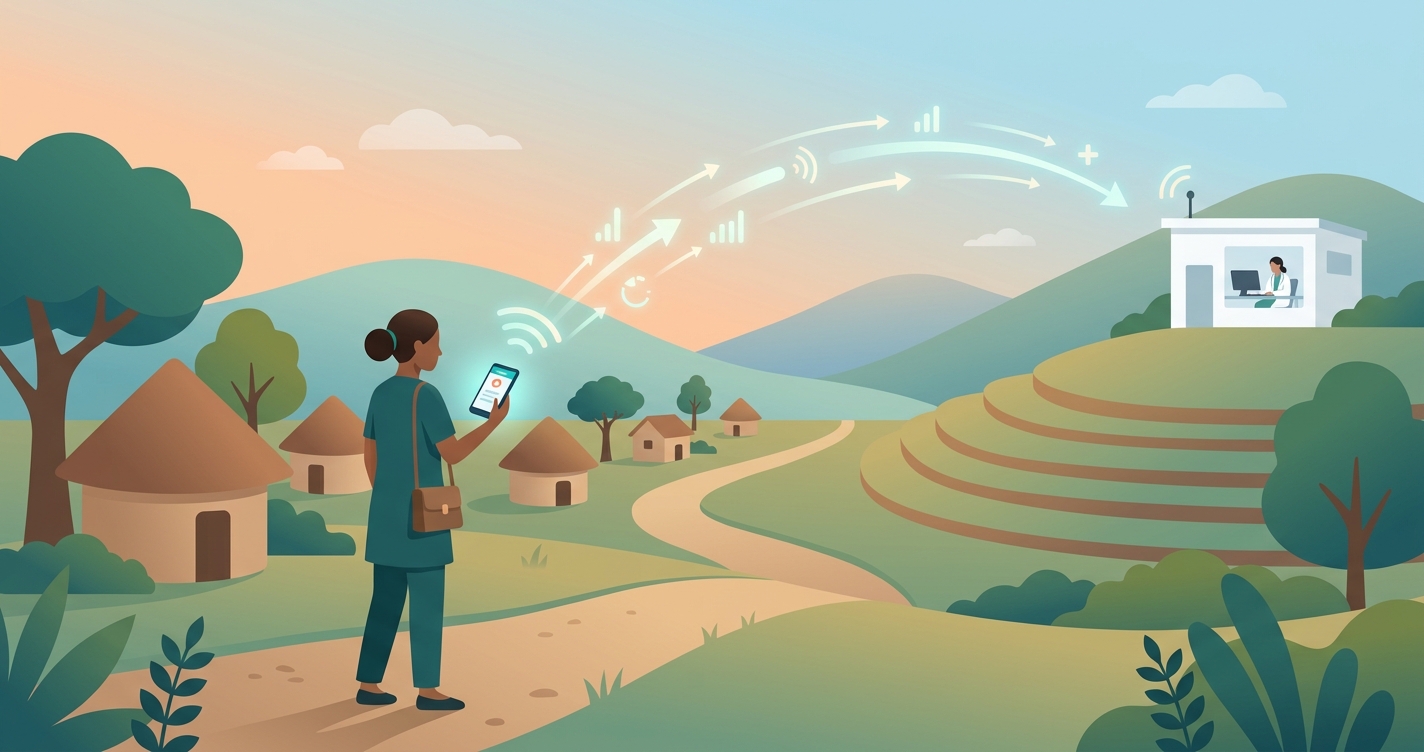
When a clinician is responsible for a population spread across dozens of villages connected by dirt roads, the binding constraint is rarely medical knowledge. It is information. Who is sick, how sick, and how fast their condition is changing are questions that traditionally required a person to travel to a building with equipment, electricity, and trained staff. For most rural populations that building is hours away, and the data it would have produced never gets recorded. The practical answer that has emerged over the past decade is not a new clinic but a new data pathway: smartphones in the hands of community health workers, feeding structured measurements back to a central team. The accumulated mHealth deployment stories from Sub-Saharan Africa and South Asia now form a body of evidence that grant-making bodies and public health institutions can actually evaluate, rather than a collection of anecdotes.
A 2023 systematic review by Alenoghena and colleagues described the scarcity and poor quality of routine health data as a primary obstacle to evidence-based practice across Africa, noting that in many rural districts the data a clinic would have generated is simply never captured at all.
What mHealth deployment stories reveal about fast remote data
The phrase mHealth deployment stories covers a wide range of programs, but the successful ones share a structural logic. Instead of asking patients to reach a facility, they push a lightweight data-capture tool out to where people already are. A community health worker registers a household, records vitals or symptoms on a phone, and the record syncs to a district dashboard the moment a network signal is available. A clinician who never leaves the district office can then review, triage, and respond.
This inversion matters because it changes who waits. In the clinic model, sick people wait for access. In the deployment model, data moves toward the decision-maker while the patient stays home. The 2024 evidence syntheses on community health worker mHealth use in Sub-Saharan Africa associated this approach with measurable increases in antenatal care uptake, facility-based births, and postnatal follow-up, suggesting the data pathway does more than digitize paperwork. It changes behavior on both sides of the encounter.
Several recurring program archetypes appear across the literature:
- Maternal and child health tracking, such as the YendaNafe application in rural Malawi, which was linked to more new antenatal visits and earlier first-trimester contact.
- Supervisory and logistics tools, such as the Mobenzi platform in South Africa, which tracked household visits and cut supervisor travel time.
- Referral and teleconsultation links, used by community health workers in Nepal's mountainous regions to consult urban clinicians on complex cases.
- National reporting integration, exemplified by India's ASHA program, where mHealth tools standardize maternal and child health indicators for upstream analysis.
How the data actually travels
The technical pattern is consistent. Capture happens offline because connectivity cannot be assumed. Records queue on the device and transmit opportunistically when a signal appears, often at the end of a day's route rather than in real time. The clinician therefore works from a near-current picture rather than a live feed, which for most non-emergency triage is sufficient. The speed gain comes not from instant transmission but from eliminating the weeks of delay built into paper registers that must be physically collected, transcribed, and entered.
Comparing how remote health data gets collected
The table below contrasts the dominant approaches public health programs use to obtain health data from populations without nearby clinics. The comparison is drawn from patterns reported across the deployment literature rather than any single product.
| Approach | Time to usable data | Equipment burden | Geographic reach | Data quality risk |
|---|---|---|---|---|
| Paper registers collected periodically | Weeks to months | Low (forms, pens) | Limited by collection logistics | High (transcription, loss) |
| Patients travel to a fixed clinic | Only when patient arrives | High (facility-bound) | Poor for distant households | Moderate, but biased to who can travel |
| Mobile clinic visits | Days per visit cycle | Very high (vehicle, devices) | Route-dependent | Moderate |
| CHW with smartphone data capture | Hours to one day | Low (phone, app) | Wide, follows worker routes | Lower with validation rules |
| Contactless vitals on a CHW phone | Minutes per person | Very low (phone only) | Wide, high throughput | Emerging, under active study |
The pattern that stands out is that the marginal device cost falls as the data pathway shortens. Approaches that put more capability onto a phone the worker already carries scale faster because they do not require new hardware to be procured, maintained, calibrated, and replaced across hundreds of sites.
Industry applications for institutions and funders
For the academic researchers, public health institutions, and grant-making bodies who design and fund these programs, mHealth deployment stories are most useful when read as operational evidence rather than promotional material. Several application areas recur.
Maternal and child health programs
This is the most documented domain. Cross-regional studies on mobile health for maternal and child outcomes report improvements in visit timing and continuity of care when community health workers carry data tools. For funders, the appeal is a relatively clear outcome chain: earlier contact, more complete records, and a measurable referral pathway.
Surveillance and population screening
Programs that screen large numbers of people for early warning signs benefit from the throughput of phone-based capture. A worker can register and record far more people in a market-day setting than a single cuff-and-clipboard workflow allows, producing population-level data that would otherwise never exist. This is where contactless vitals capture is being explored, because measurement time per person is the binding constraint at scale.
Supervision and program integrity
Tools that log where and when visits happen address a long-standing concern of grant-making bodies: verification. The South African Ward-Based Outreach Team studies documented how visit-tracking data lets supervisors manage by exception rather than by travel, lowering oversight cost while raising accountability.
Current research and evidence
The evidence base has matured from feasibility pilots toward effect measurement. The 2024 systematic review evaluating mHealth adoption by community health workers for maternal health services in Sub-Saharan Africa found consistent associations with increased service uptake, while also cautioning that study designs vary and that strong randomized evidence remains thinner than the volume of deployments would suggest. Qualitative work on community health workers adopting mHealth in rural Malawi documented real adoption barriers: device charging, intermittent connectivity, digital literacy, and the time cost of learning new tools.
Alenoghena and colleagues (2023) frame the underlying problem precisely, arguing that infrastructure gaps and limited analytic capacity, not just data collection, constrain how much value a country can extract from the records it gathers. This is an important nuance for funders. Collecting data faster only helps if someone downstream has the capacity to interpret and act on it. The most durable deployment stories pair field capture with investment in district-level analysis and clear referral logic, a point reinforced across the digital health sustainability literature.
A second consistent finding is the gap between pilot success and program survival. Many initiatives that demonstrate strong early results do not outlast their initial funding cycle, which has pushed researchers and funders to treat sustainability, local ownership, and integration with national health information systems as primary evaluation criteria rather than afterthoughts.
The future of mHealth deployment stories
Three directions are visible in current work. First, measurement is moving onto the phone itself. Where early deployments digitized forms, newer ones aim to capture physiological signals directly, reducing dependence on peripheral devices that break or drift out of calibration. Contactless techniques that estimate vitals from a phone camera are an active research frontier precisely because they promise high throughput with near-zero added hardware, though they remain under validation and should be reported as such.
Second, the unit of evaluation is shifting from the individual scan to the program. Funders increasingly ask for publication-ready outcome metrics, referral completion rates, and population coverage, not just device counts. This favors deployments designed for measurement from the start.
Third, integration is becoming the test of seriousness. A deployment that feeds a parallel, donor-specific database adds reporting burden, while one that writes into the national health information system strengthens the broader data ecosystem. The next generation of mHealth deployment stories will likely be judged less by novelty and more by whether they leave behind durable data infrastructure.
Frequently asked questions
How do doctors get health data from areas with no clinic?
Most commonly through community health workers equipped with smartphones. Workers capture vitals, symptoms, and household information on an app that stores records offline and syncs to a central dashboard when a network signal is available, letting a clinician triage remotely without the patient traveling.
Do these mHealth programs need internet to work?
Not continuously. Well-designed deployments capture data offline and transmit opportunistically when connectivity appears, often at the end of a route. This offline-first design is one reason the approach works in regions where reliable connectivity cannot be assumed.
What does the research say about whether mHealth deployments improve outcomes?
Systematic reviews from 2023 and 2024 associate community health worker mHealth use with higher uptake of antenatal, delivery, and postnatal care in Sub-Saharan Africa. Researchers caution that rigorous randomized evidence is still thinner than the number of deployments, and that data infrastructure and program sustainability strongly shape real impact.
Why is contactless vitals capture relevant to remote data collection?
Because measurement time per person limits how many people a worker can screen. Capturing vitals from a phone camera, where validated, could raise throughput while removing the cost and maintenance of separate devices, which matters most in large population screening settings.
The patterns across these deployments point toward a clear research agenda: shorter data pathways, lower hardware burden, and measurement built into the workflow from the start. Circadify is working in exactly this space, studying how contactless, phone-based vitals capture can support community health programs and produce evidence that institutions and funders can use. Researchers and grant-making bodies interested in the underlying studies and potential collaboration can explore the published work at circadify.com/blog.