How do health workers check a baby's heartbeat without any equipment?
Explore how frontline health workers use contactless vitals technology to monitor newborn heartbeats in low-resource settings, replacing the need for traditional medical equipment.
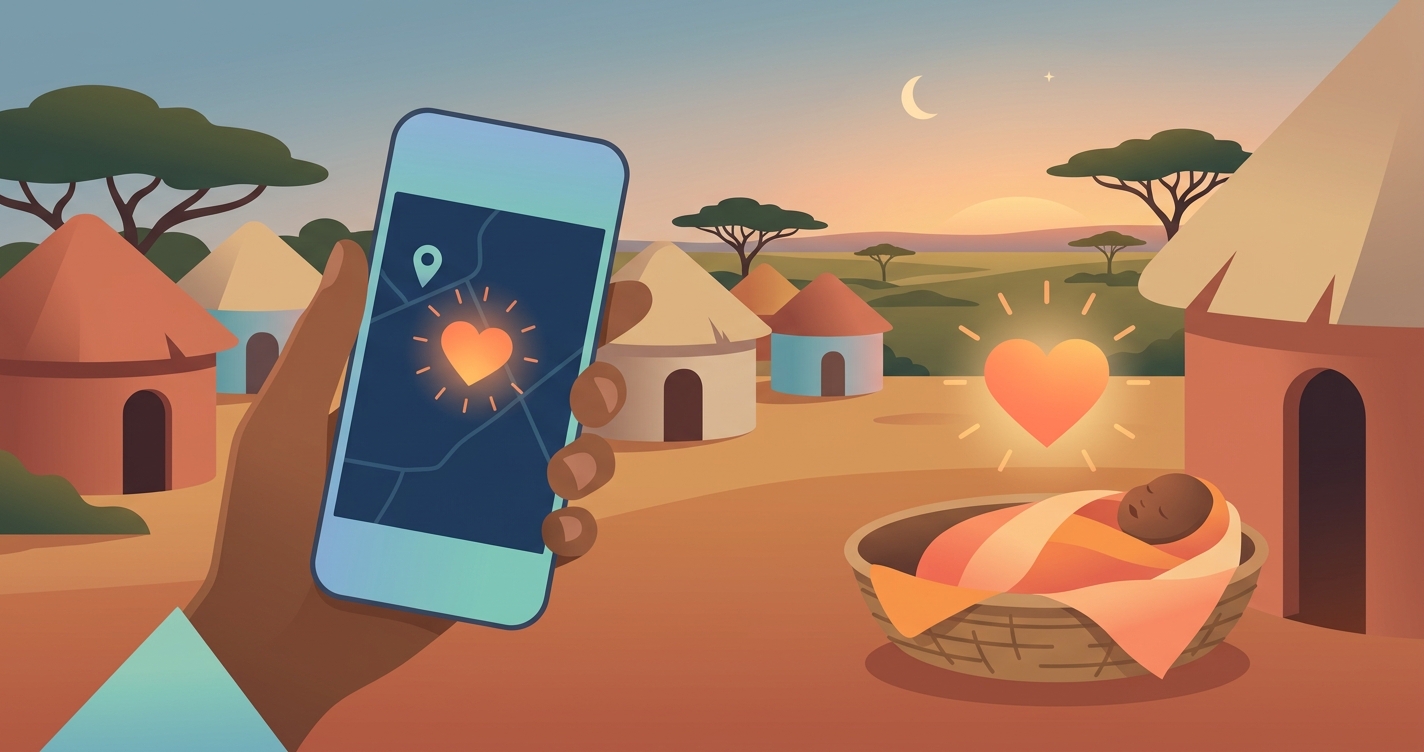
The first few hours and days of a newborn's life are a critical window. Timely and accurate assessment of vital signs, particularly heart rate, is fundamental for identifying distress and enabling life-saving interventions. In well-equipped hospitals, this is a routine procedure involving stethoscopes and pulse oximeters. But in many community health settings across the globe, such equipment is a luxury. For community health workers (CHWs) operating in remote villages or conducting home visits, the question is not just how to check a baby's heartbeat, but how to do so reliably and consistently with limited resources. Traditionally, this has relied on manual methods like palpating the umbilical cord or brachial artery, techniques that require significant skill and are prone to subjectivity. Today, however, the proliferation of mobile technology is creating a new paradigm for neonatal assessment in the field.
"Every year, 2.4 million newborns die, with the highest rates in sub-Saharan Africa and Southern Asia. Access to timely and effective care is a critical factor in preventing many of these deaths." - World Health Organization (WHO), 2023
The shift to contactless vitals in community health
The primary challenge in field-based neonatal assessment is the trade-off between accessibility and accuracy. Manual methods are accessible but their reliability is highly dependent on the CHW's training and experience. A study on neonatal resuscitation noted that heart rate assessment via palpation could be inaccurate. This variability is a significant issue when a rapid, correct decision is needed. This is the gap that contactless vitals community health programs are designed to fill. By using the cameras on standard smartphones, these programs utilize a technology called remote photoplethysmography (rPPG). The phone's camera detects minute, non-visible changes in the color of the baby's skin, which correspond to the pulsing of blood. Advanced algorithms then process this video feed to calculate a heart rate, and often respiratory rate, in real-time. This approach moves the assessment from a subjective feeling to an objective, shareable data point, fundamentally changing the nature of community-based neonatal care. It empowers CHWs, regardless of their experience level with manual techniques, to gather a reliable vital sign measurement.
| Feature | Manual Palpation | Auscultation (Fetoscope) | Smartphone rPPG (Contactless) |
|---|---|---|---|
| Equipment | None | Pinard horn or fetoscope | Standard smartphone |
| Training Required | High; sensitive touch | Moderate; listening skills | Minimal; app-based workflow |
| Data Objectivity | Low; subjective count | Moderate; subjective count | High; algorithmic calculation |
| Data Recording | Manual entry | Manual entry | Automatic; digital log |
| Cost per Assessment | Effectively zero | Low (device cost) | Very low (uses existing hardware) |
| Use in Noisy Areas | Difficult | Very difficult | Unaffected |
The benefits of transitioning to a digital, contactless method extend beyond just the measurement itself. When a vital sign is captured via a smartphone app, it becomes part of a digital record. This creates opportunities for:
- Longitudinal tracking of a newborn's health over time.
- Geotagging data to understand health trends at a village or district level.
- Immediate data sharing with supervisors or referral clinics.
- Standardizing care protocols across a large cadre of health workers.
Industry Applications
The deployment of contactless vitals technology is not a theoretical exercise. It is actively being integrated into global health programs, demonstrating tangible impact across several areas.
Antenatal and postnatal monitoring
While the focus is often on the newborn, this technology is equally valuable for monitoring the mother's heart rate during antenatal and postnatal visits. A single, versatile tool that can serve both mother and child enhances the efficiency of a CHW's home visit. This dual utility is a key driver of adoption in programs where resources are scarce.
Empowering community health workers
Perhaps the most significant impact is on the CHW workforce itself. Providing CHWs with tools that are simple to use yet produce trusted, objective data elevates their role in the community and the formal health system. In deployments across East Africa, Circadify has observed that CHWs equipped with smartphone-based screening tools are often regarded with greater authority and trust by the families they serve. This digital enablement is a crucial component of task-shifting, allowing CHWs to perform screenings that were previously the domain of more highly trained nurses.
Informing public health strategy
When thousands of individual health screenings are aggregated, they form a powerful dataset for public health surveillance. Ministries of health and program managers can analyze this real-time data to spot trends, allocate resources, and evaluate the effectiveness of their interventions. For example, a sudden cluster of high respiratory rates in a specific district could signal a localized outbreak, prompting a targeted response. This data-driven approach is a major leap from paper-based systems with long reporting delays.
Current research and evidence
The scientific community has been actively investigating the efficacy of smartphone-based rPPG for several years. A study led by Helge-Sindre H. Lura and published in 2019 evaluated a smartphone app for neonatal heart rate assessment, finding a mean difference of just 3 beats per minute compared to standard ECGs, with a measurement time of under 3 seconds. The research, involving both pediatricians and midwives, demonstrated that the technology was both fast and accurate in a clinical setting.
Further research has explored contactless, camera-based PPG. A 2021 pilot study in a neonatal intensive care unit affirmed the potential of camera-based monitoring, though it noted challenges related to infant motion and ambient light changes, factors that are central to the design of robust field-deployable systems. Companies in this space work to develop algorithms specifically trained to overcome these real-world challenges. Real-world evidence from community-based deployments, such as Circadify's programs in Uganda and Kenya, provides critical insights into usability, CHW adoption, and impact on referral pathways. These field programs have shown that with proper training and support, CHWs can successfully integrate contactless screening into their daily workflows, leading to thousands of successful health assessments.
The future of contactless vitals in community health
The technology is not static. The future of contactless vitals community health programs lies in expanding the range of detectable biomarkers and integrating the data more deeply into health systems. Current research is focused on adding reliable oxygen saturation (SpO2) and even hemoglobin level estimation to the suite of camera-based measurements. The application of artificial intelligence (AI) to these datasets will enable risk stratification, helping to identify which newborns are at the highest risk and need immediate attention. As these technologies mature, they will become indispensable tools for preventative care, moving beyond simple measurement to predictive health monitoring, even in the most remote settings.
Frequently asked questions
Q: How accurate is a smartphone camera at checking a baby's heart rate? A: Studies have shown that remote photoplethysmography (rPPG) via smartphone can be very accurate. Research has demonstrated that the measurements are often comparable to standard clinical tools like ECGs, with a very small margin of error, typically within a few beats per minute.
Q: What kind of training does a health worker need to use this technology? A: Minimal training is required. The process is typically guided by a simple, user-friendly mobile application. This is a significant advantage over traditional methods like palpation, which require extensive practice and skill to perform accurately. Most community health workers can be trained in a single session.
Q: Can this technology work on all skin tones? A: Yes. The algorithms used in modern rPPG systems are designed and validated to work effectively across a wide range of skin tones. The technology measures the reflection of light from subcutaneous blood flow, a principle that is consistent across different ethnicities.
The data and insights gathered from large-scale contactless vitals programs are creating new opportunities for academic and public health partnerships. For institutions interested in collaborating on field studies, accessing anonymized data sets for analysis, or understanding the methodologies behind successful mHealth deployments, Circadify's research provides a comprehensive foundation. Explore the field studies and data at circadify.com/blog (research).