How Contactless Vitals Reach Communities Without Clinics
Answers how phone-based vitals extend care to clinic-less areas, with reach metrics and insights into rural health worker deployments.
The structural barrier of geographic distance remains one of the most stubborn challenges in global healthcare delivery. In large swaths of Sub-Saharan Africa, reaching the nearest health facility requires hours of travel over rugged terrain, making regular checkups impossible for millions. For public health institutions evaluating new deployment models, contactless vitals community health strategies are fundamentally changing how last-mile populations are screened. By shifting diagnostic capabilities from fixed brick-and-mortar clinics directly onto the mobile phones carried by field workers, remote populations can finally access preventative care.
"In many rural areas of Sub-Saharan Africa, large portions of the population live more than three to five hours from the nearest functioning hospital, turning geographic distance into a severe structural barrier to essential care."
- World Health Organization Access Guidelines Analysis, 2023
Redefining the point of care in clinic-less regions
The distance decay effect is a well-documented phenomenon in public health: the rate of healthcare utilization drops precipitously the further people live from a clinic. When a patient must sacrifice a full day of wages and pay for unreliable transport simply to have their blood pressure checked, they will almost always delay care until an acute emergency forces the issue. Overcoming this requires bringing the point of care directly to the patient's homestead.
Historically, community health workers have been the bridge between rural populations and the formal health system. The Africa CDC reports that approximately one million community health workers are currently deployed across the continent, though at least two million are needed to meet basic coverage goals. Equipping these workers with traditional medical devices presents immense logistical challenges. Blood pressure cuffs tear, require specific sizing for pediatric versus adult patients, and frequently lose calibration in dusty, high-heat environments. Pulse oximeters require batteries and can struggle to produce accurate readings on calloused or very dark fingers.
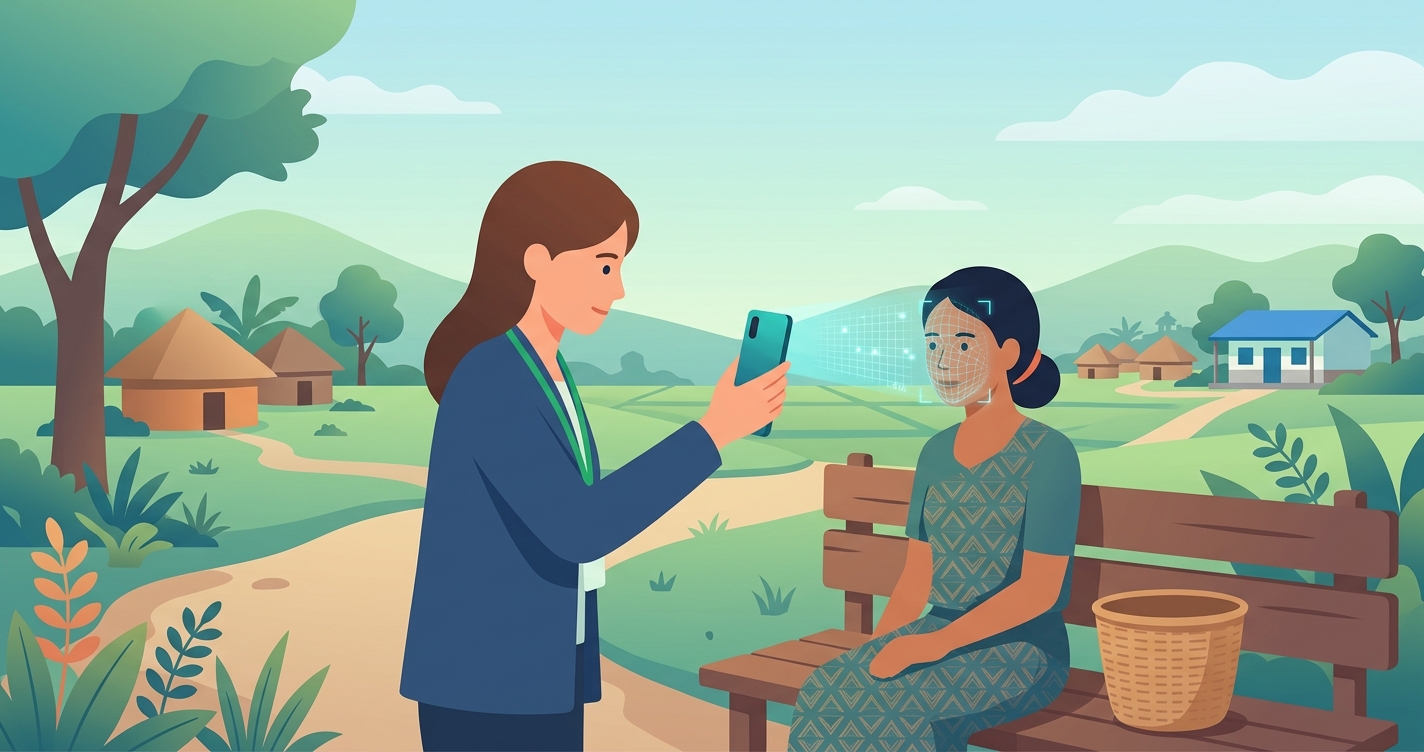
The introduction of contactless vitals community health screening using remote photoplethysmography (rPPG) software transforms an ordinary smartphone into a robust screening device. Using only the device's standard camera and ambient light, rPPG technology analyzes micro-variations in light absorption on the patient's skin with each heartbeat. This process extracts critical physiological data, including heart rate, respiratory rate, and estimated blood pressure variations, without requiring the community health worker to attach a single peripheral device to the patient.
| Factor | Traditional Field Screening | Contactless Smartphone Screening |
|---|---|---|
| Equipment Carried | Cuffs, oximeters, thermometers, spare batteries | A single charged smartphone |
| Consumables Required | Batteries, sanitizing wipes, replacement cuffs | None |
| Maintenance & Calibration | Frequent physical calibration required | Handled via software updates |
| Skill Level for Reading | Requires training on placement and cuff sizing | Intuitive camera framing |
| Infection Control | Requires sanitization between every patient | Touch-free, eliminating cross-contamination |
Deploying software-based, no-clinic health screening yields several immediate advantages for field programs:
- Increased daily screening volume per community health worker due to faster setup times.
- Elimination of cuff-sizing errors for diverse demographics, from infants to the elderly.
- Reduction in cross-contamination risks during localized infectious disease outbreaks.
- Digitized, instant data capture directly into district health databases, removing paper transcription errors.
- Lower total cost of ownership by eliminating the continuous replacement cycle of physical hardware.
Deploying last-mile vitals: practical applications
As global health funders and academic researchers design the next generation of field programs, touch-free measurement technologies are being applied to some of the most pressing clinical challenges in remote areas.
Cardiovascular risk assessments in remote villages
Non-communicable diseases, particularly hypertension and cardiovascular disease, are rising rapidly across low- and middle-income countries. Undiagnosed hypertension acts as a silent killer in communities without clinics. By utilizing camera-based vital sign estimation, field teams can conduct rapid cardiovascular risk assessments at village market days or during door-to-door campaigns. Instead of carrying heavy kits, a single health worker can screen dozens of adults using a phone, flagging those with severe anomalies for immediate referral to a district hospital.
Antenatal care and maternal monitoring
Consistent antenatal care is critical for reducing maternal mortality, yet pregnant women in remote regions often cannot walk ten miles to a clinic for routine monitoring. Community health workers equipped with contactless screening applications can routinely check the resting heart rate and respiratory rate of expectant mothers in their own homes. Early detection of physiological stress allows health workers to escalate care and arrange transport before a crisis occurs during labor.
Infectious disease triage and outbreak management
During infectious disease outbreaks, the safety of the community health worker is critical. Physical contact with potentially infected patients increases the risk of transmission and requires extensive personal protective equipment, which is often in short supply. Remote screening allows a worker to maintain a safe distance while capturing a patient's respiratory rate, a critical indicator of severe respiratory infections like pneumonia or severe viral pathogens.
Current research and evidence
The shift toward mobile-based health screening is supported by a growing body of peer-reviewed research and large-scale clinical trials. A 2022 randomized controlled trial published in PLOS Medicine analyzing community health worker-facilitated telehealth for moderate-to-severe hypertension care in Kenya and Uganda demonstrated that shifting diagnostic and monitoring tasks to equipped field workers significantly improves blood pressure control compared to standard clinic-based care. The researchers highlighted that bringing the tools directly to the community bypasses the distance and cost barriers that typically prevent patients from seeking regular checkups.
Further research published in the MDPI Journal of Personalized Medicine (2023) detailing community health worker-led cardiovascular disease risk screening in Sub-Saharan Africa confirms that digital tools significantly improve data accuracy and referral compliance. When health workers use integrated mobile platforms to capture vital signs and demographic data simultaneously, district health officers gain real-time visibility into regional health trends.
Regarding the specific application of remote photoplethysmography, ongoing validation studies registered with ClinicalTrials.gov (2023-2024) are rigorously testing rPPG-derived cardiovascular parameters against standard clinical measurements in diverse community settings. A primary focus for these academic researchers is ensuring the algorithms perform accurately across all skin tones. Recent advancements in deep learning models trained on highly diverse datasets have largely mitigated historical bias in optical sensors, making modern rPPG a viable and equitable tool for global health deployments.
The future of contactless vitals
The next five years will likely see a transition from isolated pilot programs to national-level integrations of contactless health screening. Grant-making bodies and international non-governmental organizations are increasingly demanding rigorous, real-time outcome data to justify funding allocations. Paper registries and disjointed hardware readings can no longer meet these reporting requirements.
As mobile networks expand further into rural territories and smartphone penetration deepens across the Global South, the infrastructure to support advanced digital health tools is already in place. Future iterations of this technology will likely integrate artificial intelligence to provide predictive analytics directly on the mobile device. A community health worker will Capture a patient's vital signs. Will also receive an immediate, software-generated risk stratification score based on the patient's history and current readings.
This evolution will completely redefine the concept of a clinic. The physical building will remain essential for complex procedures, emergency interventions, and specialized care. However, the initial point of contact, screening, and chronic disease monitoring will become fully decentralized, existing wherever a community health worker stands with a smartphone.
Frequently asked questions
What are contactless vitals in community health?
Contactless vitals refer to the measurement of physiological signs, such as heart rate and respiratory rate, using standard smartphone cameras and software, rather than physical cuffs or sensors. In community health, this allows field workers to conduct health screenings without carrying specialized medical equipment.
How accurate is remote photoplethysmography (rPPG) in field settings?
Modern rPPG technology has achieved high correlation with standard clinical devices for metrics like resting heart rate and respiratory rate. Accuracy in the field depends on proper lighting and minimizing patient movement, which community health workers are trained to manage during the brief scanning window.
Can community health workers use this technology offline?
Yes. Many digital health platforms designed for remote deployments are built with offline-first capabilities. The smartphone processes the optical data locally to generate the vital sign readings and caches the encrypted health record until the worker returns to an area with cellular connectivity to sync the data.
Does contactless screening replace the need for physical clinics?
No. Contactless screening acts as a powerful triage and monitoring mechanism. It identifies at-risk individuals who need medical attention and monitors chronic conditions in the community, ensuring that limited physical clinical resources are reserved for patients who truly need specialized, in-person care.
Public health institutions and grant-making bodies require scalable, evidence-based tools to expand their reach into remote regions. Integrating software-based screening directly into existing mobile deployments allows organizations to monitor population health without the friction of hardware supply chains. Circadify is actively addressing this space by building tools that help field teams capture actionable health data in any environment. To learn more about preparing your organization for digital deployment and to review detailed field research, visit the Circadify Research and Collaboration Hub.