How a District Health Office in Uganda Reduced Referral Delays With Screening Data
A field-based analysis of how a district health office Uganda referral delays screening strategy can improve handoffs, follow-up, and local decision-making.
How a District Health Office in Uganda Reduced Referral Delays With Screening Data
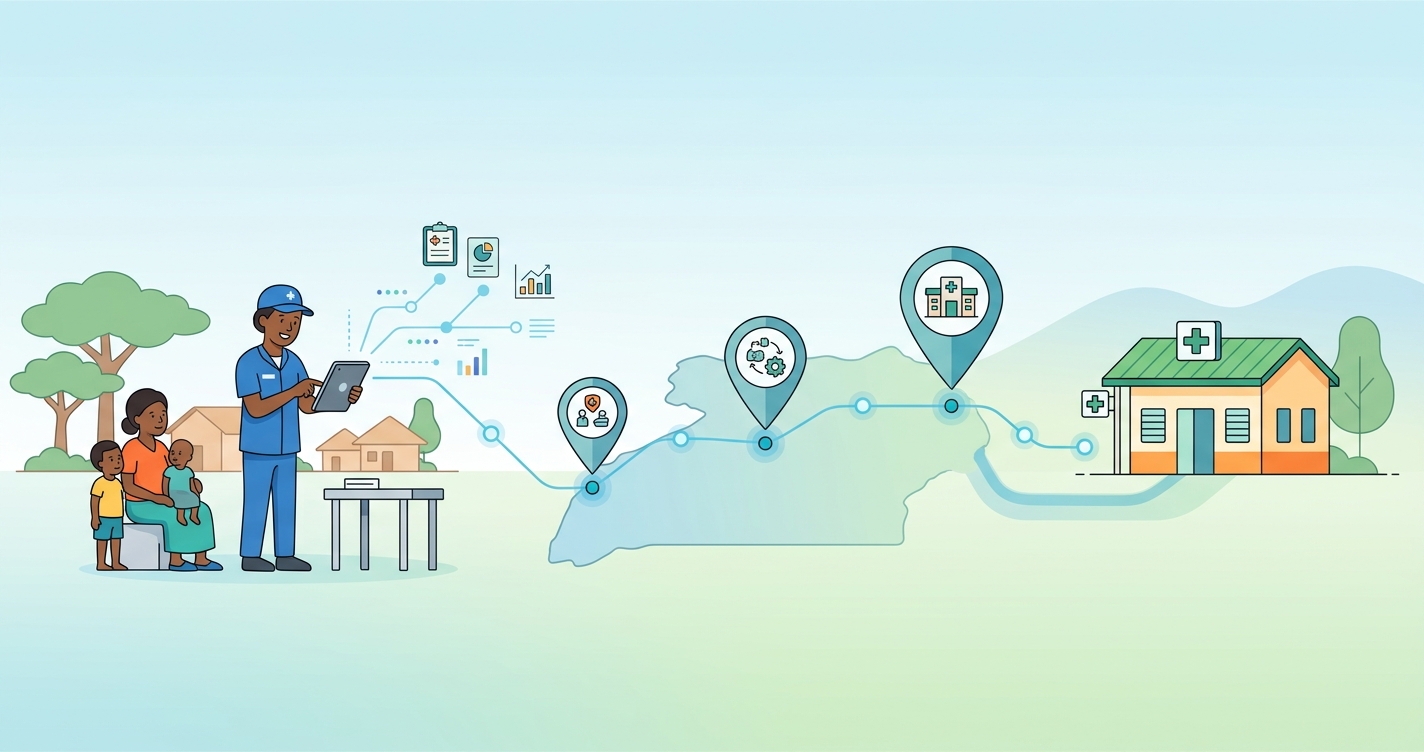
District health office Uganda referral delays screening problems usually do not start with the screening tool. They start in the gap between a community finding and a facility response. A worker identifies risk in a village, writes down the result, and tells the patient to go. Then the trail gets thin. The facility does not know who is coming. The district team cannot tell which referrals were completed. By the time someone notices the delay, the useful moment has passed.
In a 2025 Uganda study, Andrew Marvin Kanyike and colleagues screened 5,215 adults through Village Health Teams, found elevated blood pressure in 22.4%, and then watched the referral cascade narrow fast: only 23.8% accepted referral, and only 24.8% of those who accepted reached a facility.
District health office Uganda referral delays screening lessons from the field
The most useful district-level improvement is usually not dramatic. It is better visibility.
Once a district health office can see which villages are generating referrals, which facilities are receiving them, and where the drop-off happens, the conversation changes. Staff stop arguing in generalities about "weak follow-up" and start seeing specific choke points: one facility with long queues, one sub-county with transport barriers, one screening campaign that creates volume without a matching clinic schedule.
Uganda's community-health evidence has been pointing in that direction for years. Jana Jarolimova, Stephen Baguma, Palka Patel, and colleagues reported in Malaria Journal in 2018 that 89% of caregivers in a western Uganda program said they sought further evaluation after a child referral. That is a strong result, but it came in a setting where the next step was locally legible and the health concern felt urgent. Chronic-disease screening behaves differently. The district office has to work harder to keep the pathway intact.
What changes when referral data becomes visible
| Referral step | Low-visibility workflow | Data-guided district workflow | Likely effect |
|---|---|---|---|
| Screening event | Paper record stays with worker | Referral logged by site and date | District can spot volume spikes early |
| Facility handoff | Receiving clinic waits passively | Facility expects referral traffic | Less confusion at arrival |
| Follow-up | No one knows who failed to arrive | Missed referrals flagged by location | Outreach can target the real gap |
| Supervision | Generic review meetings | Facility-by-facility bottleneck review | Faster local fixes |
| Planning | Staff rely on anecdotes | District uses pattern data | Transport, staffing, and outreach can be shifted |
That kind of visibility does not eliminate delay. It just turns delay into something the district can track, argue over, and usually improve.
What a district office can actually do with screening data
A district office is not a research institute. It needs the data to do ordinary work better.
The first use is triage. If one health center keeps receiving referrals days late, the district can check whether the issue is transport, staffing, clinic flow, or poor communication from the screening team.
The second use is supervision. A district team can compare referral completion rates across sub-counties and ask why one area converts screening into treatment better than another.
The third use is campaign design. Screening programs often look productive because they generate large numbers. But if the receiving facilities are unprepared, the campaign may just create a backlog. Data helps district teams time outreach to actual service capacity.
I keep coming back to that point because it is easy to romanticize screening. Finding cases matters. Still, the district office usually wins or loses on the middle step. Not detection. Handoff.
- It can map which screening sites create the most referrals.
- It can identify which facilities have the slowest response.
- It can flag chronic conditions where patients do not feel urgency.
- It can assign supervisors to the places where referral leakage is worst.
- It can make donor reporting more honest by separating screening volume from completed care.
Industry applications for public-health institutions and researchers
District management and primary-care coordination
A district health office can use screening data to decide where to place outreach clinics, ambulances, supervision visits, and community follow-up. That sounds administrative, but it changes patient experience quickly. If referrals bunch up in one facility while another sits underused, data can show it.
Maternal and newborn referral systems
Uganda's maternal-referral literature shows why district coordination matters. A mixed-methods study on obstetric referral processes in southwestern Uganda described delays tied to transport, communication gaps, and documentation problems. Kampala's emergency call and dispatch center, described in Global Health: Science and Practice, is a more urban example of the same idea: referrals move better when coordination is visible and someone owns the chain.
Research and grant evaluation
For academic researchers and funders, screening data is useful only if it helps explain outcomes. A district dashboard that shows referral completion by sub-county is more informative than a glossy report listing total people screened. It helps answer harder questions: Did the program shorten delays? Did certain clinics absorb referrals better? Did field follow-up improve attendance?
Current research and evidence
The Ugandan evidence base is messy, but the pattern is clear.
Kanyike and colleagues' 2025 hypertension-screening study is probably the sharpest reminder that referral delay is not a side issue. The screening itself worked. Among the people who reached care, 94.3% were confirmed hypertensive. The leak was between detection and attendance.
Jarolimova and colleagues' 2018 child-referral study shows the opposite scenario. Referral completion can be high when families understand the urgency, trust the worker, and know the receiving facility. That is useful because it shows delay is not inevitable. It is contextual.
District data systems matter here too. Irene Atimango, Wilber Ssembogere, and colleagues, writing on DHIS2 use in Uganda, found that data use is often limited by weak infrastructure, inadequate training, competing responsibilities, and uneven local ownership. Those are not glamorous findings, but they explain why district offices sometimes know they have a referral problem without having the data discipline to manage it.
There is also a field-workforce dimension. Community referral systems depend on frontline workers who can explain risk clearly and revisit households when needed. Research on Village Health Teams in Uganda has repeatedly shown that capability, supervision, and support shape whether the referral pathway stays alive after the first contact.
For related context on this microsite, see After the Scan: How Referral Pathways Work in the Field and How Village Health Teams in Uganda Use Screening Technology.
The future of district-level referral management in Uganda
The next real upgrade is not more dashboards for their own sake. It is closed-loop follow-up.
District offices are moving toward systems that can tell whether a referral was generated, whether the patient arrived, and whether the facility acted. That is a much better use of digital health than simply converting paper into screens.
I do not think every district needs a sophisticated command center. Most need something simpler: reliable referral logs, cleaner facility feedback, and a way to see which bottlenecks repeat week after week. Once those basics are in place, lighter screening technologies become more valuable because they are feeding a system that can respond.
That is also where solutions like Circadify fit the broader picture. The interesting part is not just portable screening. It is whether portable screening can plug into a referral loop the district can actually manage.
Frequently Asked Questions
Why do referral delays persist after community screening in Uganda?
Because screening is easier to decentralize than follow-up care. Delays usually come from transport costs, weak communication, clinic congestion, low patient urgency, or poor district visibility into where referrals are getting stuck.
What can a district health office learn from screening data?
It can learn which villages generate referrals, which facilities receive them slowly, and where patients drop out of the pathway. That helps the district target supervision and service adjustments.
Are referral problems mainly a technology issue?
No. Technology can make the pathway easier to see, but the underlying problems are often operational: staffing, transport, clinic readiness, and follow-up.
Why was the Kanyike study important?
Because it showed a common district problem very clearly. Screening found a meaningful number of high-risk adults, but only a small share completed the referral path. That makes the bottleneck visible.
What should funders look for besides screening volume?
They should ask about referral completion, time to attendance, facility readiness, and whether the district can trace a case from community detection to confirmed care.