Is it possible to check vital signs for many people without touching them?
Field evidence on contactless vitals community health screening: how camera-based rPPG lets programs measure many people quickly without cuffs or contact.
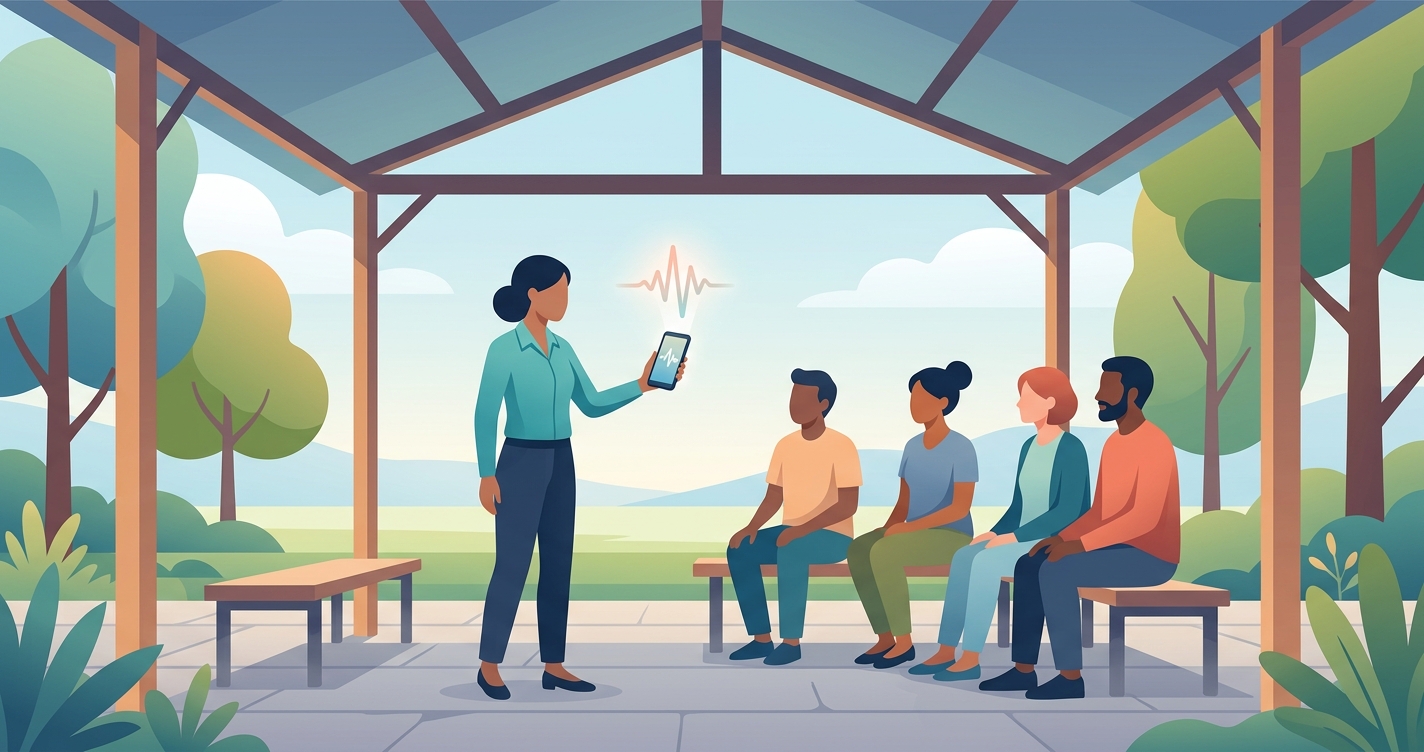
A district screening team arriving in a market town faces a problem that no clinical guideline really solves: dozens of people waiting, one blood pressure cuff, and a few hours of daylight. The traditional answer has been to triage by queue length rather than by need. A different approach is now being tested across community programs in sub-Saharan Africa, where a smartphone camera reads pulse and respiration from a person's face in roughly half a minute, no cuff applied, no probe clipped to a finger. The question driving research interest in contactless vitals community health work is simple to state and harder to answer: can you reliably measure the vital signs of many people without touching any of them, and does it hold up outside a laboratory?
The underlying method is remote photoplethysmography, usually shortened to rPPG. A standard camera captures tiny color shifts in facial skin caused by blood moving through capillaries with each heartbeat. Software converts those shifts into a pulse waveform, from which heart rate, respiratory rate, and related signals can be estimated. Contact sensors do the same job by pressing against skin. The contactless version trades a small amount of signal strength for an enormous gain in throughput, hygiene, and acceptability.
A 2023 evaluation of a smartphone rPPG application reported heart rate accuracy around 97 percent and systolic blood pressure estimation near 94 percent in normotensive adults, while respiratory rate trailed at roughly 84 percent, illustrating that not all vital signs are measured with equal confidence.
What contactless vitals community health screening actually measures
It helps to separate what the technology does well from what remains under active study. Heart rate is the most mature output, with multiple peer-reviewed evaluations placing camera-based estimates close to contact reference devices in controlled conditions. Respiratory rate is derived from the same video and is generally usable for population triage, though it is more sensitive to movement. Blood pressure estimation from rPPG is the most contested claim in the field and should be treated as a screening signal that flags people for confirmatory measurement, not as a replacement for a validated cuff.
For public health institutions weighing deployment, the value is not in any single reading. It is in the ability to capture structured vital sign records from hundreds of people per day, attach them to a registry, and route the outliers to follow-up. A reading that is approximately right for ninety-five people, combined with confirmatory testing for the five flagged as abnormal, changes the economics of population screening more than a perfect reading taken on a tenth of the queue.
The table below compares the dominant measurement modes used in community settings.
| Attribute | Contactless rPPG (camera) | Contact PPG (finger clip) | Manual cuff and count |
|---|---|---|---|
| People screened per hour | High (30-60s per scan, no setup) | Moderate (device reset per person) | Low (manual inflation and timing) |
| Consumables and hygiene | None; no shared contact surface | Shared probe, cleaning needed | Shared cuff, cleaning needed |
| Equipment cost | Existing smartphone | Dedicated device per worker | Cuff and trained timing |
| Vital signs captured | HR, respiration, screening BP signal | HR, SpO2, pulse | HR, BP, respiration |
| Main limitation | Motion, lighting, skin-tone validation | Throughput and device supply | Speed and operator variability |
| Best role | Mass first-pass triage | Targeted confirmation | Gold-standard confirmation |
Read together, the modes are complementary rather than competing. Camera-based screening widens the funnel; contact devices and cuffs confirm what the funnel surfaces.
Why no-touch matters in field programs
Several practical advantages explain the academic and donor interest in contactless approaches:
- Throughput. Removing cuff inflation and probe placement collapses the per-person time, which is the binding constraint on screening-day coverage.
- Infection control. A no-contact reading eliminates a shared surface, a meaningful consideration after the operational lessons of recent outbreak responses.
- Hardware economics. The 2024 wave of remote monitoring projects across Rwanda, Nigeria, and South Africa relied heavily on devices that community health workers already carry, lowering the capital barrier.
- Acceptability. Families interviewed by researchers from the University of Cape Town in Khayelitsha described non-invasive screening as less intimidating, particularly for children and older relatives.
- Data structure. Because the reading is software-generated, it lands directly in a digital record, reducing transcription error compared with paper registers.
Where it fits in community workflows
In practice the strongest deployments treat contactless vitals as the first station in a chain. A community health worker registers a person, runs a scan, and the software flags anything outside expected ranges. Flagged individuals move to a second station for confirmatory measurement and, where indicated, referral. This mirrors the referral-pathway logic that determines whether screening programs succeed or quietly fail once the screening day ends.
Limits researchers keep flagging
The literature is consistent about constraints. A 2025 analysis found that rPPG accuracy can fall sharply at elevated heart rates, which matters precisely for the unwell people a program most wants to catch. Motion, variable outdoor lighting, and camera quality all degrade signal. Most importantly for African deployments, several reviews in 2024 emphasized that algorithms must be validated across the full range of skin tones, because models trained on narrow populations can underperform on the people they are meant to serve.
Current research and evidence
The evidence base sits at an early but accelerating stage. Controlled validation studies, including work published on medRxiv in 2023 on smartphone rPPG applications, establish that camera-based heart rate is broadly credible in cooperative adults. Reviews in Frontiers and MDPI through 2023 and 2024 document rapid gains from deep learning methods that suppress motion and lighting artifacts, while cautioning that real-world robustness lags laboratory results.
The gap that public health researchers are now working to close is field validation at population scale. The 2024 Global Digital Health Monitor recorded measurable readiness gains in countries including Kenya, Nigeria, Chad, and Sierra Leone, creating the digital infrastructure on which contactless screening can run. Remote monitoring partnerships announced in 2024 across South Africa demonstrated that community health workers can collect and transmit structured vital data where clinicians are scarce. What remains comparatively thin is peer-reviewed reporting on contactless accuracy in dusty, sunlit, high-throughput field conditions with diverse populations. This is the precise space where independent field datasets, rather than vendor claims, will determine adoption.
The Future of contactless vitals in community health
Three trajectories look likely over the next few years. First, the measurement set will broaden cautiously. Heart rate and respiration are already field-usable; blood pressure and oxygen estimation will remain screening signals pending stronger validation. Second, validation will become demographically explicit, with funders increasingly expecting evidence of performance across skin tones and age groups before scaling. Third, the unit of evaluation will shift from the individual reading to the program. Grant-making bodies are already asking less about whether a single scan is accurate and more about whether a screening pathway moves people into care faster than the status quo.
For academic and public health institutions, the productive stance is neither uncritical enthusiasm nor dismissal. Contactless screening is a throughput technology that should be deployed where its strengths apply, paired with confirmatory measurement where precision is required, and reported transparently so the evidence base can mature. The deployments most worth studying are those that publish their false-positive rates, their referral completion, and their performance disaggregated by population, because those are the numbers that will tell whether no-touch screening earns a permanent place in community health systems.
Frequently asked questions
Can a phone camera really measure vital signs without touching anyone?
Yes, within limits. Remote photoplethysmography reads small color changes in facial skin to estimate heart rate and respiration, and controlled studies report heart rate accuracy near 97 percent in cooperative adults. Accuracy declines with movement, poor lighting, and elevated heart rates, so it is best used for first-pass triage rather than diagnostic measurement.
Is contactless screening accurate enough for blood pressure?
Blood pressure estimation from a camera is the least settled claim in the field. Some 2023 studies report systolic accuracy around 94 percent in normotensive adults, but most researchers recommend treating camera-based blood pressure as a screening signal that flags people for confirmation with a validated cuff, not as a standalone measurement.
Does skin tone affect contactless vital sign accuracy?
It can. Multiple 2024 reviews stress that rPPG algorithms must be validated across diverse skin tones, because models trained on narrow populations may underperform. For deployments in Africa, demographically explicit validation is a prerequisite, and funders increasingly expect performance reported by skin tone and age group.
How many people can one worker screen with contactless vitals?
Because a scan takes roughly 30 to 60 seconds with no cuff or probe to apply, throughput is far higher than manual methods. The practical limit becomes registration and queue management rather than the measurement itself, which is why programs report screening several hundred people in a single market day.
Circadify is working in this space by documenting real community health worker deployments and the field evidence behind contactless screening, with an emphasis on transparent, population-scale results rather than laboratory claims. Researchers and public health institutions interested in the underlying studies or in collaboration can explore the research library at circadify.com/blog.