Contactless Vitals in Community Health: What the Evidence Says
An evidence review of contactless vitals in community health: how camera-based vital sign checks perform in field settings, what studies show, and open questions.
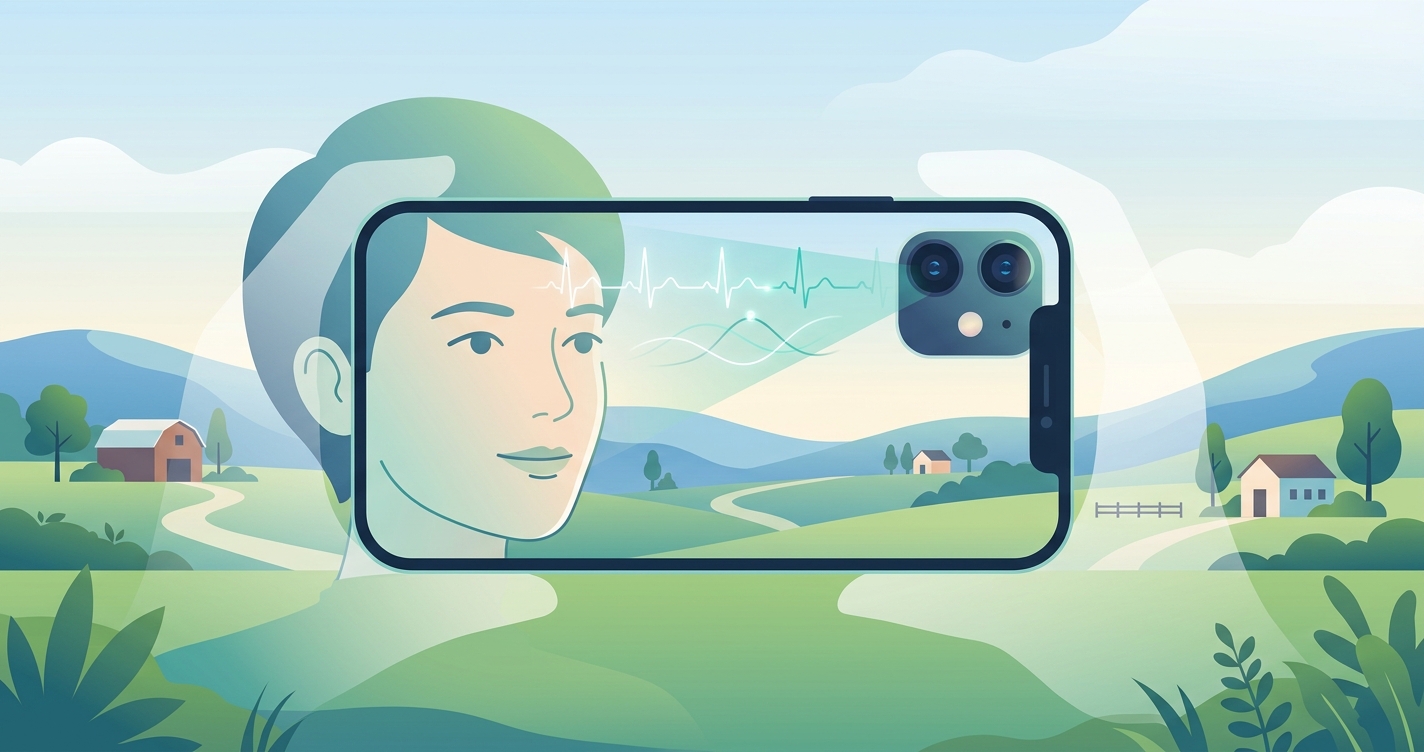
Touch-free vital sign measurement has moved from laboratory novelty to a tool that district teams now carry into market towns and homesteads on an ordinary smartphone. For evaluators weighing whether to fund or study these methods, the central question is no longer whether a camera can read a pulse from a person's face, but how well contactless vitals community health programs perform once they leave the controlled conditions of a validation lab. The evidence base is uneven, growing quickly, and worth reading carefully before any deployment claim is taken at face value.
A 2024 review of remote photoplethysmography studies reported mean absolute errors for heart rate often below 3 beats per minute under controlled conditions, while cautioning that motion, lighting, and skin tone diversity remain the largest sources of error in real-world use.
What the evidence says about contactless vitals community health programs
The dominant method behind touch-free vital signs screening is remote photoplethysmography, or rPPG. A standard camera detects subtle color changes in the skin caused by the cardiac pulse, and an algorithm converts that signal into a heart rate, and increasingly into respiratory rate, oxygen saturation, and estimated blood pressure. The physics is well established. The open question for community programs is how the signal survives outdoor light, movement, low-cost handsets, and a population whose skin tones are poorly represented in most training datasets.
Published validation work clusters into three tiers of confidence. Heart rate is the most reliable, with multiple smartphone studies reporting errors in the low single digits of beats per minute. Respiratory rate and oxygen saturation follow, with usable but wider error margins. Blood pressure estimation from a camera remains the least settled, with results that researchers describe as promising rather than proven. Crucially, almost all of these figures come from clinic or laboratory settings. Camera-based vitals evidence collected in villages, outdoors, on shared devices, is still thin, which is precisely the gap that field programs are positioned to fill.
The table below summarizes how the main vital signs compare across the dimensions that matter to an evaluator.
| Vital sign | Typical reported accuracy (controlled) | Strength of field evidence | Main error sources |
|---|---|---|---|
| Heart rate | Mean absolute error often under 3 bpm | Moderate | Motion, low light |
| Respiratory rate | Within roughly 2-3 breaths per minute | Limited | Movement, breathing depth |
| Oxygen saturation (SpO2) | Within a few percentage points in many studies | Limited | Skin tone, camera quality |
| Blood pressure | Moderate, high variability | Very limited | Calibration, individual physiology |
| Overall screening triage | Useful for sorting, not diagnosis | Emerging | Compound of the above |
A few patterns are worth drawing out from the literature:
- Heart rate is the safest claim a program can make, and the one most defensible in a grant report.
- Accuracy figures from clinics do not transfer automatically to outdoor screening days.
- Device heterogeneity matters; results on a flagship phone may not hold on a budget handset distributed across a worker network.
- Triage value is often higher than absolute accuracy value, because sorting who needs follow-up does not demand laboratory precision.
- Skin tone bias is the single most consequential validity threat for African and South Asian populations.
Where touch-free vital signs screening fits in field programs
Contactless methods do not replace the clinical instruments that confirm a diagnosis. They change the economics of the first step, which is finding the people who need one. A worker arriving at a gathering of dozens of people, holding one cuff and one pulse oximeter, faces a throughput problem that no clinical guideline solves. A camera-based check removes the bottleneck of single-use contact devices and the consumables they require.
High-volume screening days
The clearest application is rapid population screening, where the goal is to flag elevated heart rate, abnormal respiratory rate, or a combination of signs that warrants a closer look. Here the comparison group is not a hospital monitor; it is often no measurement at all. Even an imperfect touch-free reading expands coverage to people who would otherwise leave unscreened.
Maternal and child health outreach
Antenatal and child health visits depend on repeat contact, and anything that shortens the measurement step or makes it less intimidating can raise return rates. Programs documenting contactless health checks in villages have reported value in lowering the friction of routine measurement, though the causal evidence linking the technology itself to better attendance is still being assembled.
Surveillance and referral triage
When readings feed a structured digital record rather than a paper register, district offices gain a dataset they can act on. The measurement quality only needs to be good enough to rank risk and route referrals correctly, a lower bar than diagnostic certainty, and one the current evidence supports more comfortably.
Current research and evidence
The most active research front is not raw accuracy but fairness across skin tones, and this is the issue that should concern any institution deploying in Africa. Melanin absorbs more light, which lowers the signal-to-noise ratio of the rPPG signal in darker skin. A 2025 narrative review of photoplethysmography across diverse skin tones, published in the peer-reviewed literature, found wide variability between devices, with some underestimating heart rate by 10 to 15 beats per minute or more for darker-skinned users while others performed well. The lesson is that bias is a property of a specific implementation, not of the method as a whole, and must be tested device by device.
Researchers are responding on several fronts. A UCLA team led by work published in 2022 combined camera and radar measurements, refined with machine learning, to improve accuracy and fairness across a range of skin tones. The PhysFlow method, introduced in 2024 by researchers publishing through the British Machine Vision Association and arXiv, uses conditional normalizing flows to augment skin tone diversity in training data, directly targeting the dataset gap that produces biased models. A Brown University group has been developing a polarization-sensitive sensor, projected around 2025, that favors signals from deeper blood vessels to reduce melanin-driven error. Encouragingly, at least one remote monitoring study has reported a mean absolute error of about 3 bpm for heart rate across all skin tone groups, showing that parity is achievable with the right design.
What the field still lacks is large, independent validation in the exact conditions community programs face: outdoor light, motion, inexpensive cameras, and representative populations. Most published datasets remain short on darker skin tones. This is why field-data partnerships matter more than another clinic study. The strongest contribution a deployment program can make to the evidence base is rigorously collected, reference-compared readings from the populations and devices that the literature has so far underrepresented.
The future of contactless vitals in community health
Three trajectories are likely to shape the next few years. First, accuracy reporting will become more honest and more granular, with error margins broken out by skin tone, lighting, and device class rather than averaged into a single headline figure. Evaluators should expect, and demand, that level of disclosure. Second, the value proposition will settle around triage and coverage rather than diagnostic replacement, aligning claims with what the evidence actually supports. Third, regulatory and ethical scrutiny of algorithmic fairness will intensify, making representative validation data a prerequisite for credible deployment rather than an afterthought.
For researchers, the implication is direct. The questions that need answering are field questions, and they can only be answered with field data gathered under real conditions and compared against reference instruments. The programs already operating at scale across community settings are sitting on exactly the kind of evidence the published literature is missing.
Frequently asked questions
How accurate are contactless vital signs in community health settings?
Under controlled conditions, heart rate from camera-based methods often falls within about 3 beats per minute of a reference device. Respiratory rate and oxygen saturation are usable but less precise, and blood pressure remains the least reliable. Field accuracy in outdoor, high-volume settings is still being measured and tends to be lower than clinic figures.
Does skin tone affect camera-based vitals evidence?
Yes. Melanin reduces the optical signal, and a 2025 review found some devices underestimated heart rate by 10 to 15 bpm or more for darker-skinned users. However, the bias depends heavily on the specific algorithm and hardware, and recent methods have achieved comparable accuracy across skin tones, so each implementation must be validated separately.
Can touch-free vital signs screening replace clinical instruments?
No. The current evidence supports contactless checks as a triage and coverage tool that flags who needs a closer look, not as a diagnostic replacement for cuffs, oximeters, or clinical monitors. Confirmation of any abnormal reading should still use a validated clinical device.
What evidence is still missing for contactless health checks in villages?
Large, independent validation in real field conditions, outdoor light, motion, low-cost handsets, and populations with diverse and predominantly darker skin tones, remains scarce. Most datasets underrepresent these groups, which is why reference-compared field data from active deployments is the most valuable contribution researchers can make.
Circadify is working in this space alongside community health programs to close the field-evidence gap, with a focus on reference-compared readings from populations that the published literature has underrepresented. Researchers seeking access to field data, study collaboration, or the underlying methods can review the current research and partnership pathways at circadify.com/blog.