What if you could screen a whole community for early signs of sickness right from your phone?
How community health screening phone results are reshaping early detection at population scale, with field evidence from low-resource deployments.
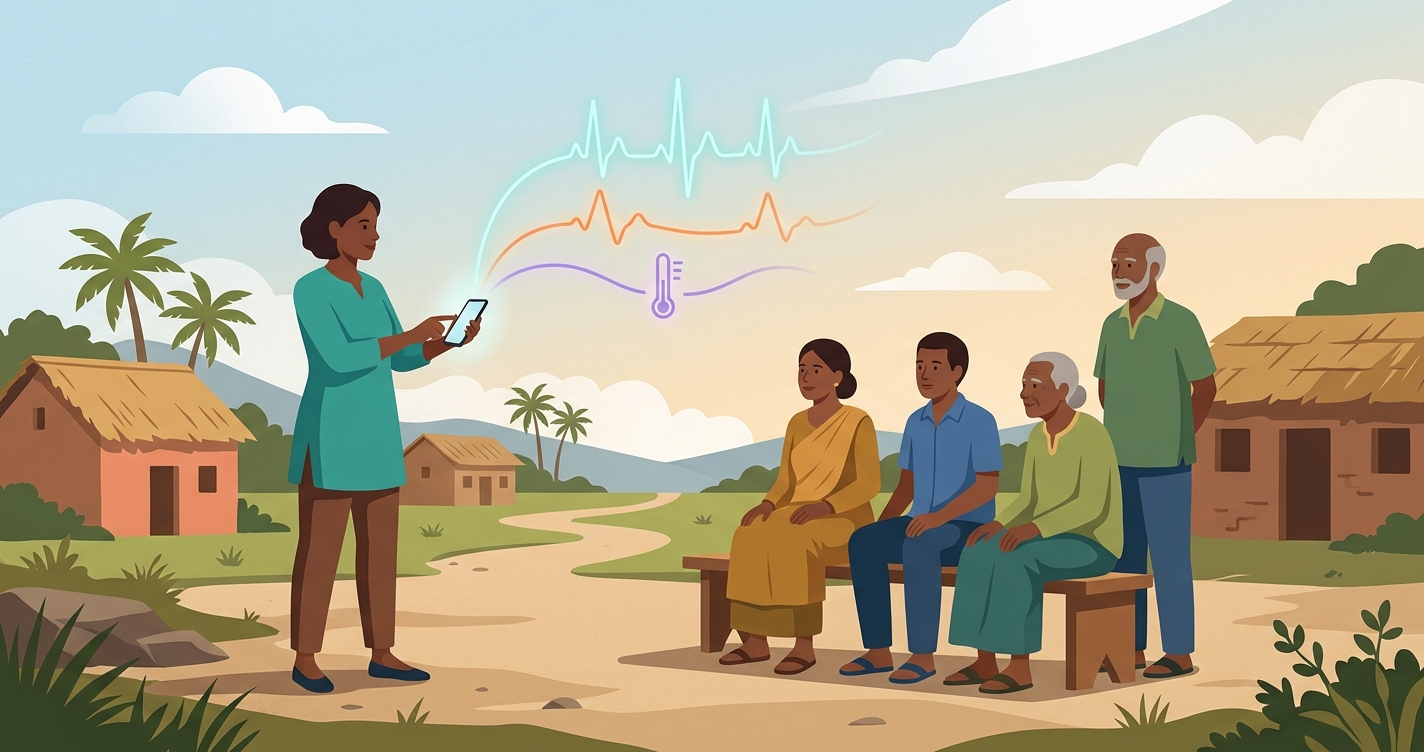
Imagine a district health worker walking into a market town with nothing more than a charged smartphone, and by the end of the day holding a structured record of blood pressure ranges, heart rate, and respiratory signals for several hundred people who had never been measured before. This is no longer a thought experiment. The combination of cheap handsets, camera-based physiology, and trained community health workers has made community health screening phone results a practical reality in places that have never had reliable access to clinical equipment. For public health institutions and grant-making bodies, the question has shifted from whether phones can capture meaningful early-warning data to how those results perform once they leave the laboratory and enter a dusty village square.
By the end of 2023, around 527 million people across Sub-Saharan Africa subscribed to a mobile service, yet smartphone ownership on the continent still sat at roughly 24 percent in 2024, far below the global average of 56 percent (GSMA Intelligence, 2024). The screening opportunity grows with every handset that closes that gap.
Why community health screening phone results matter now
The core idea is simple. A standard smartphone camera can detect tiny color changes in facial skin caused by blood flowing beneath it, a method known as remote photoplethysmography, or rPPG. From a recording of roughly 30 to 60 seconds, software can estimate heart rate and, in many implementations, respiratory rate and other derived signals. Al-Naji and colleagues, in their review of contactless vital sign monitoring (University of South Australia, 2021), describe rPPG as a maturing field whose chief promise is removing the need for contact sensors, cuffs, or consumables entirely.
That removal is what makes population-scale screening conceivable. Traditional screening drives are bottlenecked by equipment: a finite number of blood pressure cuffs, batteries, thermometers, and the supply chains that keep them calibrated. A phone-based workflow turns the device most people already carry, or that a single health worker can carry for an entire village, into the measurement tool. The result is not a diagnosis. It is a triage signal, a way to sort a crowd into those who look fine today and those who should see a clinician soon.
The need is large. The World Health Organization has long reported that a substantial share of adults living with hypertension, often cited near 46 percent, are unaware they have it. Undiagnosed conditions cannot be managed, and in low-resource settings the first contact with the health system often happens only after a crisis. Screening that meets people where they live changes the timing of that first contact.
How phone-based screening compares with conventional approaches
No single method wins on every dimension. The value of phone-based screening is best understood next to the alternatives a program manager actually chooses between.
| Approach | Cost per person screened | Equipment burden | Throughput per worker | Data capture | Best suited for |
|---|---|---|---|---|---|
| Phone-based contactless screening | Very low after device | One handset | High (hundreds per day) | Digital, automatic | Wide community drives, triage |
| Manual cuff and thermometer | Low to moderate | Cuffs, batteries, consumables | Moderate | Often paper, manual entry | Fixed clinics, confirmation |
| Wearable sensor distribution | High | One device per person | Low at scale | Digital, continuous | Longitudinal cohort studies |
| Clinic-based screening only | Moderate | Full clinic kit | Low (people must travel) | Mixed | Diagnostic follow-up |
A few patterns stand out from the field experience behind these comparisons:
- Phone-based screening shines on reach and throughput, not on diagnostic precision. It widens the funnel; it does not replace the clinician at the end of it.
- The marginal cost of one more screening approaches zero once the handset and training are in place, which is exactly the property grant-makers look for in scalable interventions.
- Digital capture removes the silent failure mode of paper registers, where data is collected but never aggregated or acted upon.
- The weakest link is rarely the measurement. It is the referral pathway that must exist for an abnormal result to translate into care.
Industry applications
Public health surveillance
When village-level screening events feed a shared database, district and national teams gain something they rarely had: a near real-time picture of population vital sign distributions. Aggregated community health screening phone results can flag clusters of elevated readings, support seasonal planning, and give surveillance systems a denominator that paper never provided. The data does not need to be perfect at the individual level to be useful at the population level.
Maternal and child health
Antenatal and child health programs are natural early adopters because the screening moment already exists. A health worker visiting a household for a routine check can add a 40-second scan without adding equipment. In several community deployments, the act of screening itself increased engagement, pulling families into contact with the formal system earlier than they would have arrived otherwise.
Noncommunicable disease detection
Hypertension and other chronic conditions are the clearest fit for opportunistic screening. Because these conditions are largely silent, the people who most need detection are the least likely to seek it. Bringing a low-friction check to markets, places of worship, and household visits reaches exactly that group.
Current research and evidence
The evidence base sits on two pillars. The first is the technical validation of rPPG itself. Reviews such as Al-Naji et al. (University of South Australia, 2021) and the broader contactless monitoring literature summarized in the Journal of Biomedical Optics (2022) document steady accuracy gains for heart rate estimation under controlled conditions, while flagging persistent challenges: motion artifacts, variable lighting, and the need for validation across the full range of skin tones. These are not footnotes. They are the precise conditions a real screening drive in bright outdoor settings must contend with, and they define where independent field validation is most needed.
The second pillar is the mHealth implementation literature. Scoping reviews of mobile health interventions for screening and early detection consistently find that multi-component programs, those pairing a digital tool with reminders, community engagement, and a clear referral route, outperform single-channel efforts. Reviews of community-engaged mHealth screening apps also note that genuinely community-led design remains rare, and that programs ignoring local context tend to stall after the pilot. The lesson for funders is consistent: the technology is necessary but never sufficient. Deployment design, training, and referral infrastructure determine whether results become outcomes.
What is still thin is published, peer-reviewed field evidence specifically on contactless phone screening at community scale in low-resource settings. The deployments exist; the documentation is catching up. That gap is itself an argument for funding rigorous evaluation now, while programs are young enough to build measurement in rather than bolt it on.
The future of community health screening phone results
Three trends will shape the next several years. First, device economics keep improving. With the median entry-level smartphone in Sub-Saharan Africa priced near 39 US dollars in 2024 and 4G connections projected to reach half of all connections by 2030 (GSMA Intelligence, 2024), the hardware floor for screening keeps dropping while capability rises. Second, the analytic side will move from single vital signs toward combined risk signals, where heart rate, respiratory rate, and contextual data together produce a more useful triage flag than any one number. Third, and most important for institutional buyers, the field will professionalize its evidence standards, with pre-registered field studies, transparent accuracy reporting across skin tones, and outcome metrics tied to referrals completed rather than scans performed.
The trajectory points toward screening as a routine layer of community health work rather than a special event. When a vital sign check costs nothing extra and takes under a minute, it can become a default part of every household visit. The constraint is no longer the measurement. It is the collective will to build the pathways that carry an abnormal result all the way to care.
Frequently asked questions
Can a phone really detect early signs of sickness accurately enough to be useful?
A phone-based scan is a screening and triage tool, not a diagnostic device. It is designed to separate people who likely need a clinical visit from those who do not. Under good conditions, camera-based heart rate estimation has shown strong agreement with reference devices in the research literature, but accuracy depends heavily on lighting, movement, and validation across skin tones, which is why independent field evaluation matters.
How is this different from a standard clinic checkup?
Clinic checkups are diagnostic and require people to travel to a fixed site with equipment and staff. Phone-based community screening reverses that, bringing a brief check to where people already are. It expands who gets measured at all, then routes those with concerning results toward the clinic for confirmation and care.
What makes phone-based screening scalable for grant-funded programs?
The marginal cost of each additional screening is very low once handsets and training are in place, and digital capture means data aggregates automatically for monitoring and evaluation. Those two properties, low unit cost and built-in measurement, are what allow a program to grow from hundreds to hundreds of thousands without a proportional rise in budget.
What is the biggest risk to these programs?
The most common failure is a broken referral pathway. Screening that identifies a problem but has nowhere to send the person creates frustration and erodes trust. Successful programs invest as much in the path after the scan as in the scan itself.
Circadify is working alongside community health programs and researchers to document how contactless, phone-based screening performs in real field conditions and how those results connect to care. If your institution is evaluating scalable screening interventions or seeking collaboration on deployment evidence, explore the research and partnership work at circadify.com/blog.