How can a 30-second phone scan help a community health worker save lives from afar?
How remote health monitoring results from a 30-second contactless phone scan help community health workers triage and refer patients faster in low-resource settings.
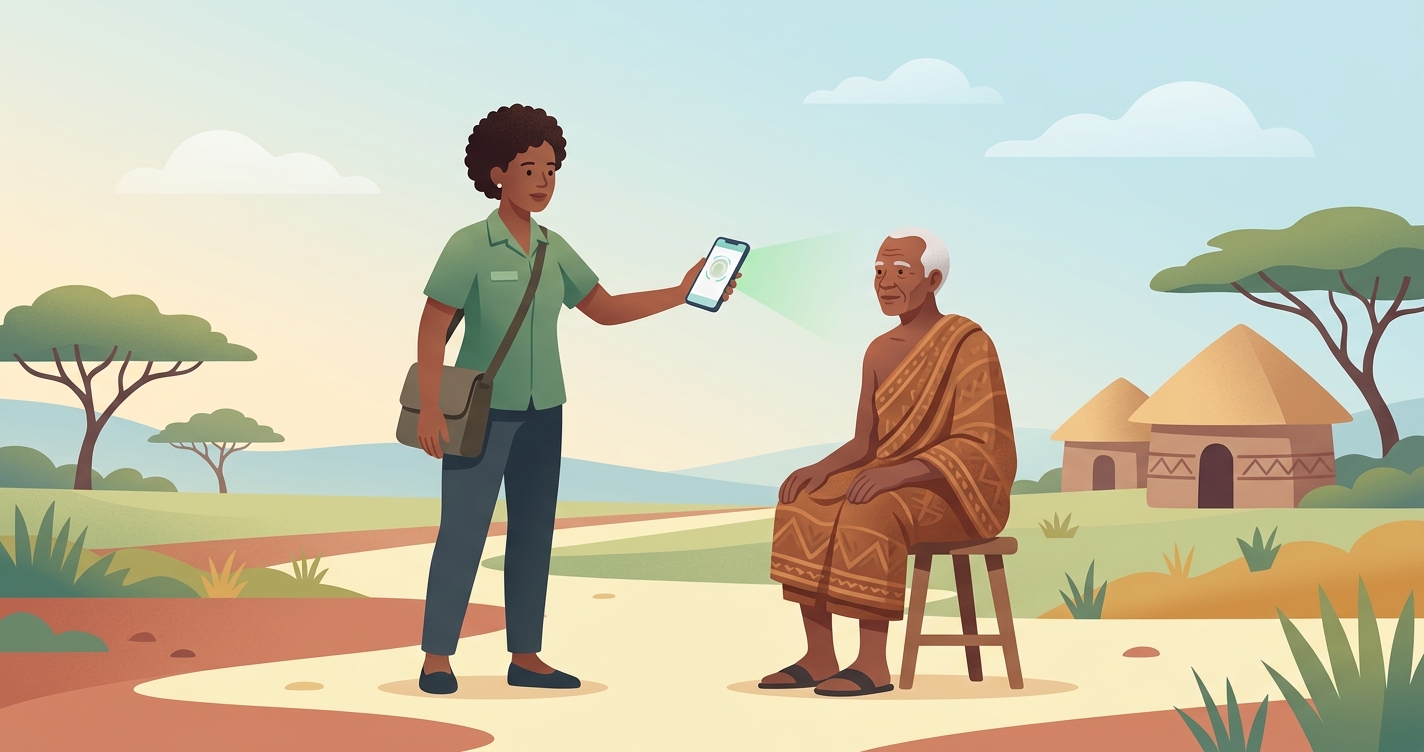
When a community health worker walks into a homestead an hour past the end of the nearest paved road, the most valuable thing they carry is not a stethoscope or a blood pressure cuff. It is the smartphone in their pocket and the half minute it takes to capture a person's vital signs from the camera alone. In that window, remote health monitoring results can move a quietly deteriorating patient from invisible to flagged, from waiting to referred. The question worth examining is not whether a 30-second scan feels impressive. It is whether the speed of that measurement, multiplied across thousands of households, changes who gets seen in time and who does not.
An estimated 3.6 billion people lack access to essential health services, and frontline workers in low-resource settings often make triage decisions with no instruments at all. Tools that compress a vital-signs reading into seconds are being studied precisely because the bottleneck is rarely treatment. It is timely recognition.
What remote health monitoring results actually capture in 30 seconds
A contactless scan relies on remote photoplethysmography, usually abbreviated rPPG. The phone camera detects tiny color changes in the skin caused by blood moving through capillaries with each heartbeat. From that signal, algorithms estimate heart rate, respiratory rate, and related cardiovascular indicators. According to a 2024 sector review published by Healthcare.Digital, rPPG is one of the emerging health-technology areas to watch through 2025, with heart rate and respiratory rate measurement considered closest to near-term community use, while blood pressure estimation still needs substantial validation.
The appeal for field programs is structural. A community health worker conducting door-to-door visits cannot carry, calibrate, clean, and power a full set of diagnostic instruments across dozens of homes a day. A scan that produces remote health monitoring results in under a minute removes the equipment chain entirely. The worker points the camera, the person sits still, and a structured record appears that can be synced, triaged, and referred.
That speed matters most for the patients who do not look acutely ill. A resting heart rate that is too high, a respiratory rate creeping upward in a feverish child, a reading that sits outside an expected range for a pregnant woman. These are the signals a rushed visual assessment misses and a 30-second capture can surface.
How a contactless scan compares to the field alternatives
The honest framing for researchers is comparative. A phone scan is not competing with a hospital monitor. It is competing with what a community health worker can realistically deploy at the doorstep, which is often nothing more than observation and a thermometer.
| Approach | Time per reading | Equipment burden | Vitals captured | Best fit |
|---|---|---|---|---|
| Visual assessment only | Seconds | None | Subjective signs | Initial impression, no record |
| Manual pulse and respiration count | 1 to 2 minutes | None | Heart rate, breathing rate | Trained workers, low volume |
| Portable cuff and pulse oximeter | 2 to 4 minutes | Devices, batteries, cleaning | Blood pressure, SpO2, heart rate | Fixed posts, supervised visits |
| 30-second contactless phone scan | Under 1 minute | Smartphone already carried | Heart rate, respiratory rate, cardiovascular indicators | High-volume household screening |
The trade-offs are real and worth stating plainly:
- A contactless scan is faster and carries no consumables, but its accuracy is sensitive to movement, lighting, and skin tone, factors that field studies continue to address.
- A cuff and oximeter capture measurements that rPPG cannot yet reliably provide, such as blood pressure, but they slow the visit and add maintenance.
- Manual counting is free but inconsistent across workers and fatiguing across a long day.
- Visual assessment alone produces no auditable record, which limits both referral follow-up and program evaluation.
The strongest deployments treat these as layers rather than rivals. A scan screens everyone quickly; instrumented confirmation is reserved for those the scan flags.
Industry applications across community health programs
Maternal and antenatal screening
Pregnancy is a period where small physiological shifts carry outsized risk. Rapid scans let workers capture baseline vitals at every home visit, building a record that travels with the woman toward antenatal care. The value is continuity. A single reading is a snapshot, but repeated 30-second captures across a pregnancy reveal trend, and trend is what prompts earlier referral.
Child illness and fever triage
For young children, the difference between recovery and crisis is often hours. Elevated heart and respiratory rates frequently precede obvious distress. A scan that flags these during a routine household sweep gives a worker grounds to escalate before a caregiver would have sought help on their own.
Population screening days
In market-town screening events, throughput is everything. A district team aiming to assess several hundred people in a day cannot spend four minutes per person on instrumented vitals. Contactless scanning compresses the measurement step so that the limiting factor becomes registration and counseling, not hardware.
Remote supervision and quality control
Because remote health monitoring results are captured digitally, supervisors can review them without traveling. A program lead in a district office can see which workers are scanning, which readings are being flagged, and where referral follow-through is breaking down. That visibility is difficult to achieve with paper registers.
Current research and evidence
The evidence base sits at an important stage: technically promising, operationally early. Validation work such as the smartphone rPPG accuracy study published on medRxiv has examined heart rate and respiratory rate agreement against clinical references, reporting strong performance for these measures in controlled conditions while noting that blood pressure estimation remains less reliable. The Healthcare.Digital 2024 review reaches a consistent conclusion, positioning heart rate and respiratory rate as the credible near-term use cases.
On the program side, the broader literature on community health workers is well established. Reviews of CHW and mHealth interventions across rural Africa consistently associate them with improved maternal and child health, higher screening coverage, and earlier disease detection, even where direct all-cause mortality effects are hard to isolate in a single study. The mechanism researchers point to is timely recognition followed by referral, the same chain a fast scan is meant to accelerate.
Two cautions deserve emphasis for any rigorous evaluation:
- Accuracy in a clinic does not guarantee accuracy in a dusty courtyard at midday. Field validation under real lighting, motion, and skin-tone diversity is the gap that matters.
- A scan only saves a life if the result triggers action. The referral pathway, not the measurement, is where outcomes are won or lost. Programs that measure scan volume without measuring referral completion risk reporting activity instead of impact.
The future of remote health monitoring results in the field
The trajectory points toward three shifts. First, expanding the reliable vitals set, with ongoing algorithm work aiming to bring additional cardiovascular indicators to field-grade confidence. Second, tighter integration between the scan and the surveillance system above it, so that a flagged reading in a village flows automatically into district and national dashboards rather than stopping at the worker's screen. Third, a maturing of evaluation standards, as grant-making bodies increasingly ask not how many scans were performed but how many flagged cases reached care and how quickly.
For academic researchers, the open questions are unusually tractable. The technology is deployable now, the data is structured by default, and the outcome of interest, time from detection to referral, is directly measurable. That combination makes contactless screening a strong candidate for the kind of field study that produces publishable, policy-relevant evidence.
Frequently asked questions
Can a 30-second phone scan really replace clinical instruments?
No, and that is not the claim worth testing. A scan is a screening and triage layer for settings where instruments are absent or too slow to use at scale. It is designed to flag who needs instrumented confirmation, not to substitute for a hospital monitor.
Which vital signs are most reliable from a contactless scan?
Current research, including the 2024 Healthcare.Digital review and rPPG validation studies, treats heart rate and respiratory rate as the closest to field-ready. Blood pressure estimation by camera still requires substantial further validation before community use.
Does speed actually translate into lives saved?
Speed creates the conditions for it by surfacing subtle warning signs earlier and across far more people. Whether that converts into saved lives depends on the referral pathway downstream. The measurement and the follow-through have to be evaluated together.
What should researchers measure to assess impact?
Beyond scan volume, the meaningful endpoints are flag rate, referral completion rate, and time from detection to care. These connect the screening step to the outcomes that grant-making bodies and ministries care about.
Circadify is working in this space alongside community health programs that want their contactless screening to be studied properly rather than simply scaled. For research collaborations, field deployment data, and published evidence on outcomes, explore the research at circadify.com/blog.